China's Renewable Push, U.S. Policy Shifts Stall Humboldt Wind Plans
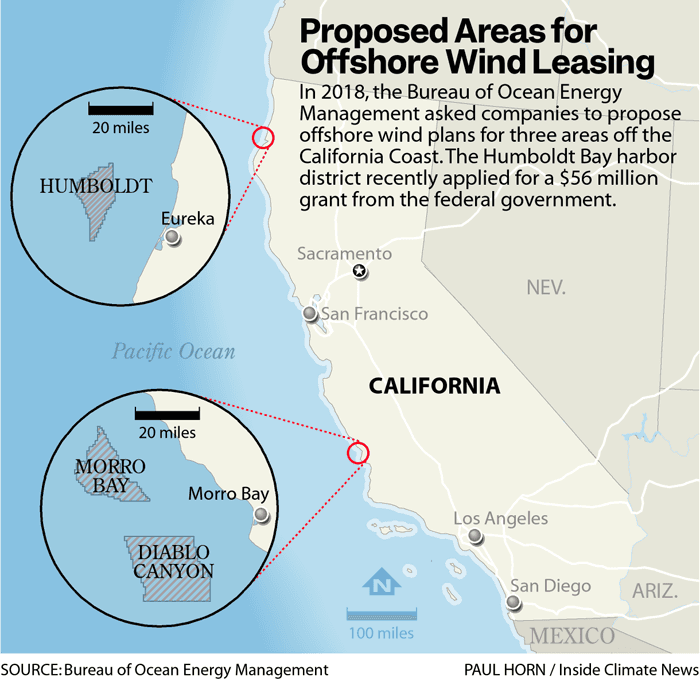
A recent investigative report by national reporters highlights how China’s rapid expansion in wind, solar and battery manufacturing is reshaping global supply chains while shifts in U.S. federal support have delayed planned renewable projects on the North Coast. The developments matter to Humboldt County because cancelled federal grants for the Humboldt Bay marine terminal have put the offshore wind timeline and local jobs at risk.

Reporters Julia Simon and Anthony Kuhn examined global renewable energy trends in 2025 and found a contrast between China’s aggressive build out of manufacturing capacity and comparatively weaker U.S. federal backing. Their reporting, which includes on the ground coverage from Eureka, places the Humboldt Bay marine terminal and proposed offshore wind development at the intersection of international market dynamics and domestic policy choices.
Locally, the marine terminal project was intended to serve as the North Coast logistics hub for offshore wind construction and maintenance. The project’s viability has been undermined by significant federal grant cancellations that have already altered planning and procurement timelines. Local officials, including leaders at the Humboldt Bay Harbor District, see immediate economic stakes in the speed and scale of federal support. With funding on uncertain footing, private investment decisions and job creation forecasts for the region are now subject to delay.
At a broader level, the report outlines how control over solar panels, turbine components and battery cells is increasingly concentrated in China. That concentration affects project costs, lead times and the bargaining position of U.S. developers. For Humboldt County, which lacks nearby heavy fabrication capacity, reliance on long supply chains adds scheduling risk and can increase the capital needed to stage large offshore projects. U.S. policy retrenchment in federal backing has compounded those market pressures, slowing progress on projects that depend on coordinated public and private investment.

The short term impact on Humboldt County includes postponed construction work, slower hiring for specialized port and maritime roles, and potential reductions in expected local spending during the development phase. Over the medium term, the region risks losing momentum in building the infrastructure that would anchor an offshore wind supply chain here, making it harder to attract future projects even if policy shifts reverse.
Long term economic implications hinge on policy choices in Washington and strategic planning locally. Strengthening local workforce training, preserving port readiness where feasible, and clarifying project financing could improve Humboldt County’s competitiveness. For now the community faces a critical window in which national policy and global market shifts will determine whether the North Coast becomes a gateway for offshore wind or a missed opportunity.