Czech president says Prague can swiftly send combat planes to Ukraine
Czech president Petr Pavel told reporters in Kyiv that Prague can provide several medium combat aircraft and may offer passive radars to help counter Russian drone attacks, a move with regional and legal implications.
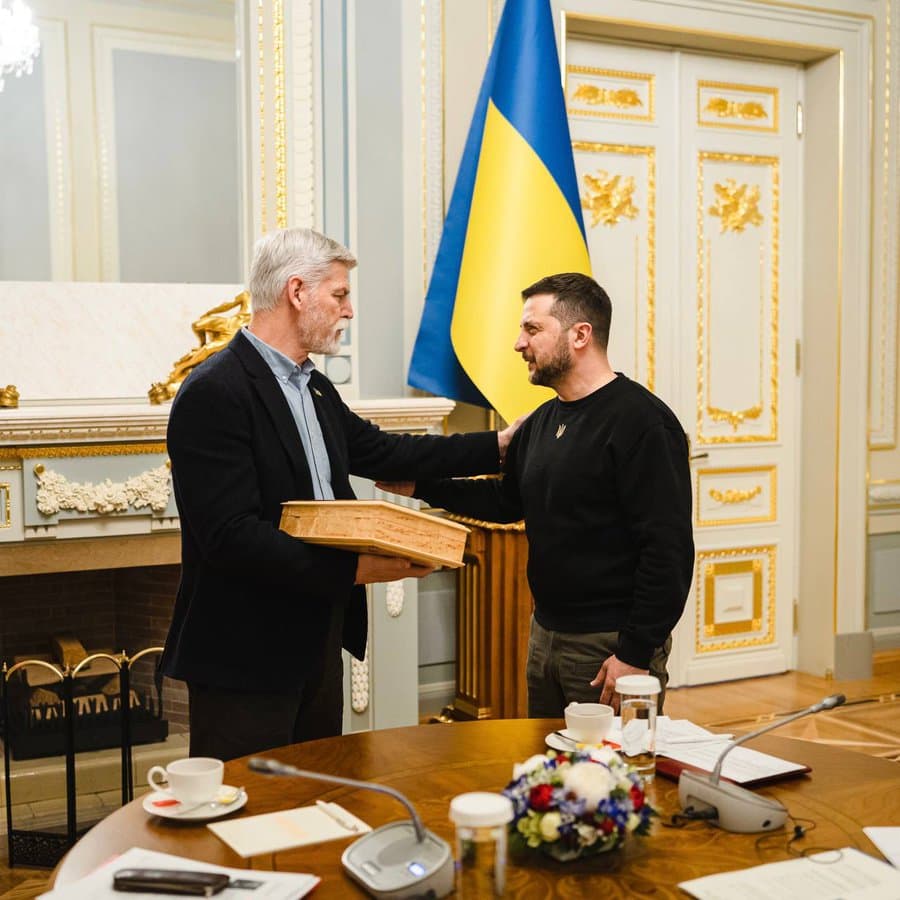
The Czech Republic can move "in relatively short time" to supply Ukraine with "several medium combat planes, which are highly effective in fighting drones," President Petr Pavel said at a joint appearance with Ukrainian President Volodymyr Zelensky in Kyiv. Pavel also said Prague might supply early-warning systems, explicitly citing passive radar technology as a possibility.
Pavel framed the offer as a pragmatic response to a persistent operational problem: the surge of Russian drones that have eroded Ukraine's air defence and struck both military and civilian targets. He did not identify aircraft models, precise numbers or delivery timetables during the press remarks, leaving critical operational and legal questions unresolved.
Czech air force inventories, however, point to clear options and limitations. Prague operates 24 Aero Vodochody L-159 ALCA light-attack and trainer jets and flies 14 Saab JAS 39 Gripens under a lease that provides its primary air-defence capability. The country has ordered 24 Lockheed Martin F-35 fighters for delivery after 2030. The L-159 is widely described by defence analysts as a low-cost subsonic light combat aircraft with payload capacity and a flexible weapons suite that can be adapted for ground attack and limited defence against slow-moving aerial threats such as many attack drones.
Pavel, a former army general and ex-chair of NATO’s Military Committee, has been an outspoken supporter of Ukraine. His presence in Kyiv underscored Prague’s political solidarity as well as the strategic calculation behind any transfer: aircraft suited to countering drones could offer immediate tactical value without the long lead times needed to reconfigure modern air-defence networks around high-end fighters.

Domestic politics complicate such transfers. The new government led by Andrej Babiš has signalled it will continue a Czech-led ammunition initiative funded by Western donors, while refusing to commit national budget funding for further aid. Previous Czech administrations authorised transfers of heavy equipment from national stocks and later replenished capabilities with allied assistance. Any aircraft transfer would likely require export approvals, financial arrangements to replace or compensate removed assets, and coordination with allies on training, basing and sustainment — all sensitive questions Warsaw and Brussels will watch closely.
Operationally, moving light combat jets to Ukraine would not be a panacea. Effective deployment demands pilot training, ground support, munitions provisioning and secure basing, as well as integration with Ukraine’s air-defence and command systems. Passive radars could augment early warning by detecting low observable or low-flying drones that conventional radar networks sometimes miss, a capability that suits the asymmetric nature of recent attacks.
Strategically, the announcement elevates Prague from donor to enabler with palpable impact on Ukraine’s medium-term defence posture. It also risks prompting a diplomatic response from Moscow and will test the limits of allied burden-sharing in a conflict that has steadily internationalized. For Kyiv the immediate question is practical: whether these aircraft and systems can be delivered and integrated quickly enough to blunt the drone threat before the next surge. Pavel expressed confidence that the issue could be "quickly and successfully" concluded; until firm model, number and funding decisions are published, the offer remains a potentially consequential pledge awaiting the complex work of implementation.
Sources:
Know something we missed? Have a correction or additional information?
Submit a Tip

