UK unveils Atlantic Bastion, major undersea defence programme
The Ministry of Defence announced development of Atlantic Bastion, an integrated undersea defence initiative to counter renewed Russian undersea activity and protect critical subsea infrastructure. The programme combines autonomous and crewed platforms, AI acoustic sensors, aircraft and digital targeting networks, with industry seed funding and early trials scheduled for 2026, a move with clear implications for defence markets and NATO deterrence posture.
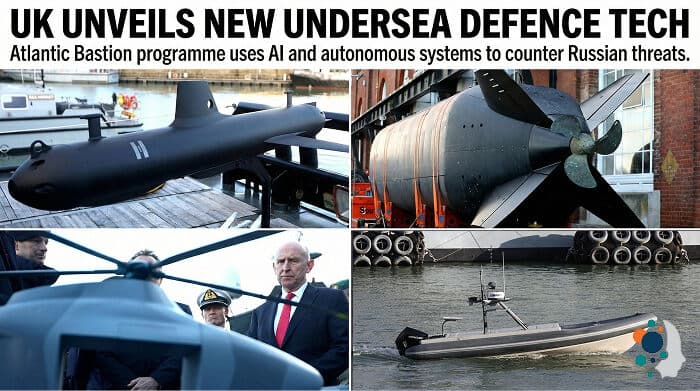
The United Kingdom moved decisively to expand its undersea defence posture on December 8, unveiling Atlantic Bastion, a programme designed to detect and, if necessary, act against threats in the North Atlantic. Defence officials described a layered approach that links autonomous and crewed vessels, aircraft, AI powered acoustic sensors and a digital targeting network intended to protect assets such as telecommunications cables and seabed pipelines.
Announced at the International Sea Power Conference alongside speeches by the First Sea Lord and the Defence Secretary, the programme responds to what ministers characterised as a sustained increase in Russian undersea activity. Officials pointed to renewed investment in undersea forces and specialised spy vessels, for example the Yantar, as evidence that the Atlantic undersea environment is returning to strategic contestation after years of relative neglect.
Industry reaction was immediate. Defence officials said initial seed funding has been awarded and dozens of companies submitted technology demonstrators spanning unmanned underwater vehicles, towed sensor arrays and machine learning packages for acoustic classification. Early capability trials are scheduled for 2026, with the Ministry signalling a phased development pathway that will aim to deliver deployable systems over several years.
The announcement has clear market implications. Procurement opportunities will flow to traditional shipbuilders and electronic warfare firms, while the biggest growth may be among smaller technology companies working on autonomy, sensors and data fusion. Analysts estimate that undersea sensing and autonomy represent a multi billion pound market over the next decade as NATO members increase investment to secure transatlantic lines of communication. Much of the modern global internet relies on undersea fibre optic cables, which carry the vast majority of intercontinental data traffic, making their protection also an economic priority for financial markets and trade.
Beyond direct procurement, Atlantic Bastion underscores shifting defence policy choices. The programme is being positioned as NATO relevant, intended to reassure allies in Canada, the United States and northern Europe about collective capacity to monitor and, if necessary, contest sub surface activity. That framing could accelerate allied burden sharing but will also require interoperable standards for sensors, communications and rules of engagement.
There are trade offs and risks. Operating offensive and defensive systems in contested waters raises legal and escalation concerns, and the mixing of military and critical civilian infrastructure protection blurs peacetime norms. The Ministry will need to balance the technical pace of AI driven detection with governance mechanisms to avoid miscalculation. Sustained investment will also be necessary to maintain an industrial base capable of producing and supporting autonomous undersea systems, a strategic goal that may prompt shifts in skills, supply chains and export controls.
Atlantic Bastion marks a strategic acknowledgement that the undersea domain has returned to centre stage. By combining new sensor technologies and unmanned platforms with conventional naval assets, Britain aims to create persistent surveillance and a deterrent posture in the North Atlantic. The programme’s success will hinge on rapid technical integration, stable funding and close coordination with NATO partners as governments confront a long term trend toward contested beneath the waves competition.