Additive Construction Moves Into Practice, Projects Span Canada United States India
Three major additive construction efforts advanced on December 27, 2025, signaling a shift from demonstrations to operational pilots in housing, military logistics, and field construction. These projects matter because they combine training, funding, and practical deployment techniques that could lower costs, speed builds, and change permitting and materials choices for local builders and planners.
Additive construction moved into operational practice over the holiday weekend as academic, military, and industrial teams reported concrete progress on three continents. The University of Windsor began work on what is described as Canada s first net zero, 3D printed multi story student residence at 1025 California Avenue, with Printerra Inc. completing the 3D printing for the entire project. The building received two million dollars in federal funding and two hundred fifty thousand dollars from Desjardins Ontario Credit Union. Designed as a living laboratory and a training ground, the seven residential units will involve close collaboration between industry partners and municipal permitting offices.
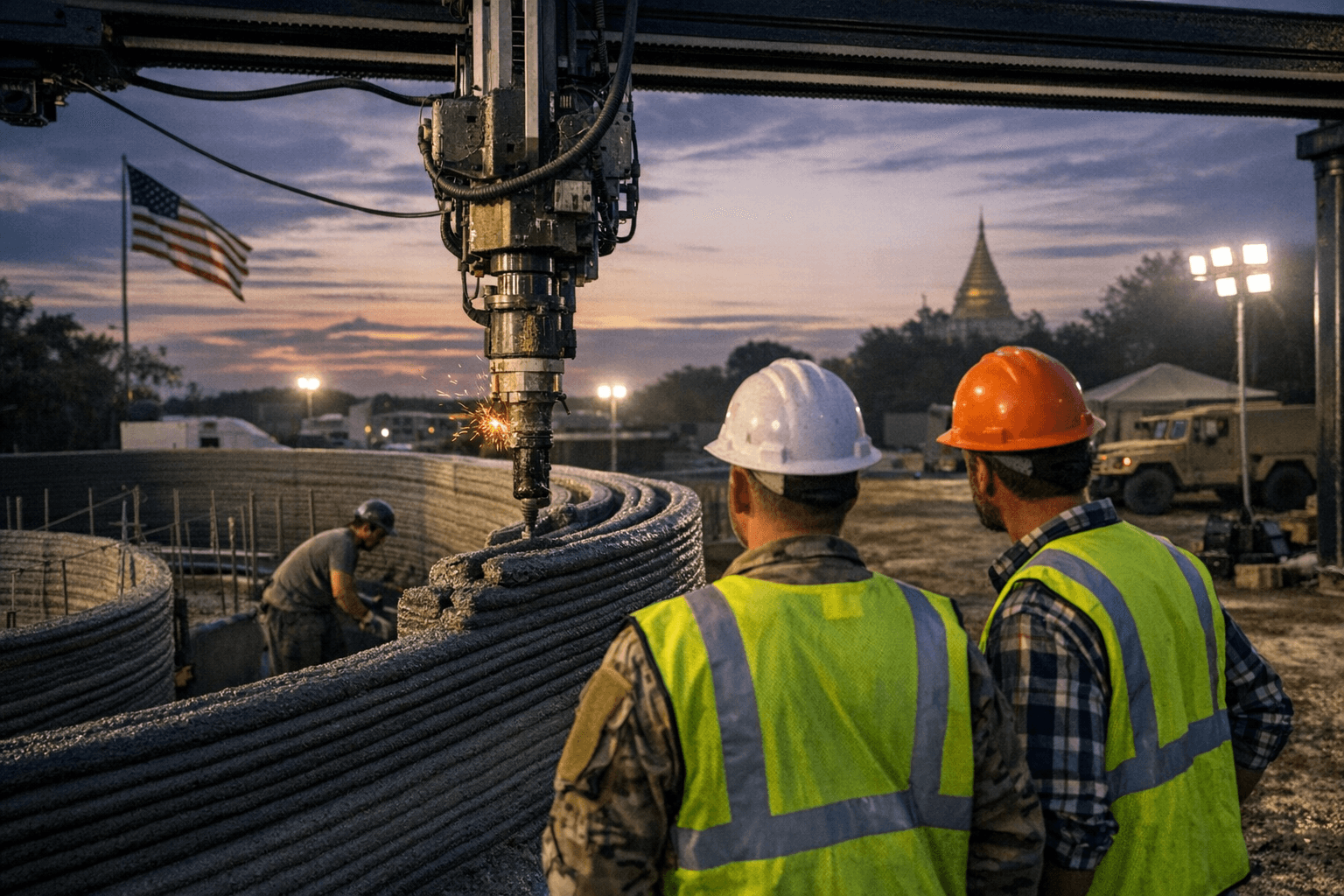
In the United States the U.S. Army Engineer Research and Development Center completed an additive construction experiment at Fort McCoy, Wisconsin. The exercise was conducted in partnership with Applied Research and Associates and several universities. The team explored materials and equipment approaches to enable printing of maneuver enabling infrastructure such as retaining walls and culverts on site using primarily locally sourced materials and small amounts of transported cement. The focus was on remote deployable construction capabilities that can be adapted to austere environments.
India reported two operational stories that underscore portability and field readiness. The Indian Army and project partners operationalized portable 3D concrete printing for forward area construction under Project PRABAL. Local firms supported deployments using indigenous robotic printers configured for rugged terrain. The mobile systems combined mixers, piston pumps, robotic manipulation, and onboard power to produce fast, customized structures in situ.
Taken together these projects show additive construction moving beyond isolated demonstrations into pilot projects with practical goals. For community makers and municipal planners the immediate takeaways are tangible. Training opportunities and living laboratory projects will accelerate workforce skills. Materials research and permitting collaboration will shape allowable feedstocks and structural approaches. Field operations in military and remote civil contexts highlight logistics advantages for using local materials and compact equipment.
Monitor permitting developments and materials standards as these pilots progress, because changes will affect local building codes and procurement choices. For anyone involved in 3D printed construction, these deployments provide concrete examples of how printing can be integrated into training programs, municipal planning, and fast response construction.
Sources:
Know something we missed? Have a correction or additional information?
Submit a Tip