China drafts rules to cap imports of advanced AI chips
Beijing is preparing limits on how many foreign advanced AI chips firms may import, a move that could restrict Nvidia H200 sales and reshape global AI supply.

China's central government is drafting rules to limit the total volume of advanced artificial intelligence chips that domestic companies may buy from foreign suppliers, people familiar with the matter say. The measures, if finalized, would set purchase caps rather than impose an outright ban, a design that could "effectively allow some sales by Nvidia instead of banning them outright."
Officials have been holding meetings with technology companies and customs authorities as they weigh how to balance the growth of a domestic semiconductor industry with Chinese firms' demand for top-tier hardware. In recent days customs agents were told that Nvidia H200 chips are not permitted to enter China, and domestic companies were explicitly instructed not to purchase the chips "unless necessary." Industry participants reported that purchases were being paused while regulators consider the draft terms.
The drafting comes after the U.S. administration approved exports of Nvidia's H200 chips to China, a decision that inflamed debate in Washington. Critics argued that permitting high-end chip sales risks bolstering China's AI capacity and could enable military applications, while supporters said controlled access might discourage Chinese firms from accelerating efforts to replicate U.S. designs. A commentator warned such an approach could "allow about 2 million advanced AI chips like the H200 to China, an amount equal to the compute owned today by a typical U.S. frontier AI company," underscoring the stakes involved in any numerical cap.
Market data underlines the potential impact. Chinese technology firms have placed orders for more than 2 million H200 chips, a demand figure that outstrips Nvidia's publicly reported inventory of roughly 700,000 H200 units. Analysts have modeled cap scenarios that would limit shipments to China to roughly 1 million H200s and possibly a similar number of the earlier H100 model. Even a capped flow at that scale could materially expand China's installed compute capacity for 2026; one analysis suggested 1 million H200s could raise installed AI compute by about 250 percent compared with relying only on domestic chips.
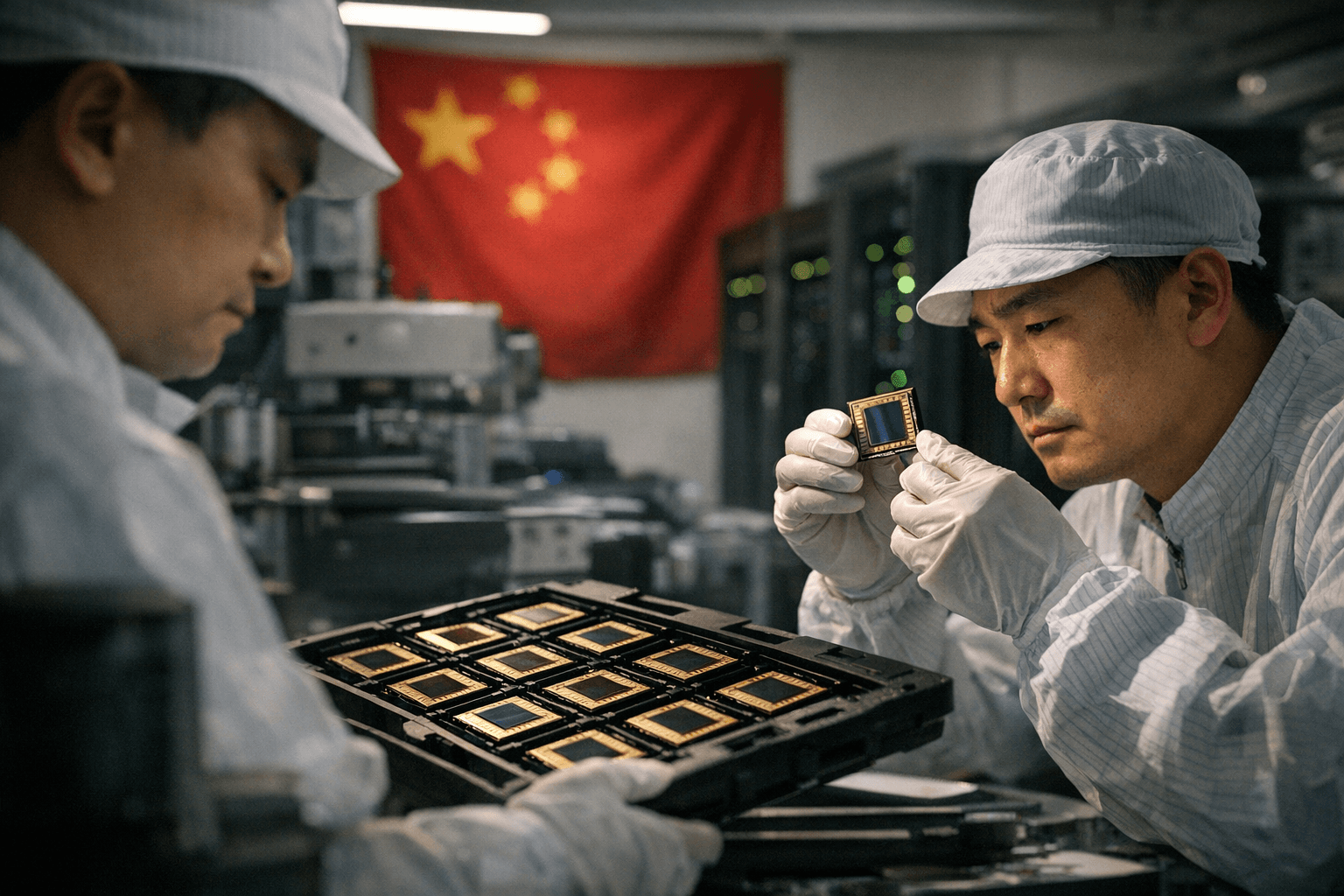
Experts caution that volumetric caps pose enforcement challenges. Caps risk creating a false sense of security if companies find alternate purchase pathways or if downstream transfers are difficult to track. One analyst described caps as a "Band-Aid," arguing that market actors and complex supply chains can undermine numerical limits unless verification and end‑use controls are robust.
Key details remain unresolved. It is not yet clear whether the draft rules will be finalized, what precise volume limits will look like, which chip models and foreign vendors will be covered, or how China would police imports and internal transfers. The government's parallel signaling to customs and technology firms suggests officials are preparing to assert tighter control, but the final policy could still allow some commercial sales under strict quotas and approvals.
The unfolding policy decision will influence global chipmakers, cloud providers, and AI research labs that rely on concentrated pools of high-end accelerator hardware. How Beijing calibrates caps and how tightly it enforces them will shape competition and risk calculations for both domestic and international players in the accelerating race for AI compute.
Know something we missed? Have a correction or additional information?
Submit a Tip