Geminid Meteor Shower Peaked Saturday Night, Observers Saw Dozens
The annual Geminid meteor shower peaked overnight Saturday into Sunday, offering viewers under dark skies dozens of visible meteors per hour and occasional bright fireballs. Scientists at NASA and the American Meteor Society noted timing differences in published peak windows but agreed the best observing was after midnight into the early morning, underscoring both the scientific value and broad public appeal of a predictable celestial display.

The Geminid meteor shower reached its highest activity overnight Saturday into Sunday, producing a steady stream of meteors for observers who relocated away from city lights and spent time letting their eyes dark adapt. Agencies and meteor experts had recommended the night of December 13 into the early hours of December 14 as the practical peak, even though official calendars from a major space agency showed a slightly different peak window around December 12 into December 13. The small discrepancy did not alter the basic advice offered to sky watchers.
Across many locations the most favorable displays were reported after midnight and in the hours before dawn, when the radiant in the constellation Gemini rose higher in the sky. Typical guidance suggested watching from roughly 10 p.m. local time through the early morning, with materially higher rates after midnight and especially between about 1 a.m. and 3 a.m. Where skies were dark and clear, experienced observers could count dozens of meteors per hour. Under ideal darkness, historical maximums cited by meteor scientists reach about 120 meteors per hour, though more conservative and typical rates fall in the range of about 40 to 50 per hour.
The Geminids are produced by dust shed from the small body 3200 Phaethon, an object variously described by researchers as an asteroid or a rock comet. Phaethon is roughly 3.17 miles across, and the dust it leaves along its orbit produces the annual stream that Earth crosses each December. Geminid particles strike the atmosphere at roughly 21 miles per second, producing bright, slow moving trails that make the shower one of the more photogenic and easily observed annual displays. Astronomical records show the Geminids were first reliably observed in the mid 1800s and grew into one of the major showers as Earth intersected progressively denser swaths of the stream.
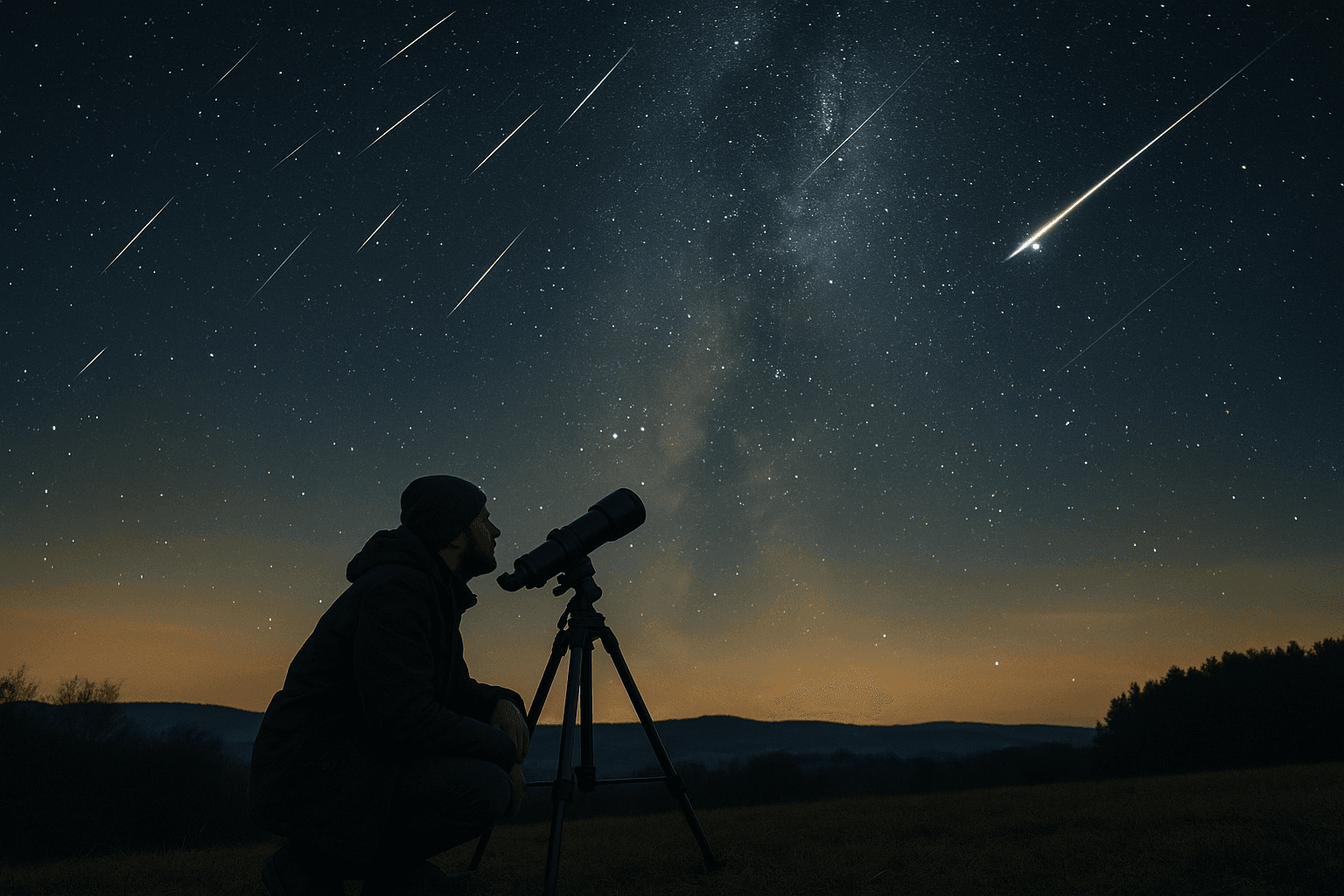
Practical advice from professional observers emphasized simplicity. No telescope or binoculars are required. A wide field view of the sky is better than magnification, and lying on one’s back with feet roughly facing south was recommended to make scanning the celestial dome easier. Observers were advised to give their eyes about 30 minutes to adapt to darkness, and to expect meteors to appear across the sky rather than only from the radiant point near Gemini. For viewers in light polluted areas, even modest travel to darker sites often produced markedly improved counts.
Beyond the spectacle, the Geminids offer public science value around the world, providing an accessible way for communities to engage with observational astronomy. The event also underscored longer term challenges, as light pollution and urban growth reduce the number of places where such displays can be enjoyed at their best. For casual watchers and photographers alike, the shower delivered a dependable seasonal moment that connected observers across continents under the same winter sky.
Know something we missed? Have a correction or additional information?
Submit a Tip