High Seas treaty to take effect January 17, 2026, reshaping ocean governance
high seas treaty will enter into force on 17 January 2026, creating the first binding global framework for ocean biodiversity. sixty ratifications triggered a 120-day countdown.
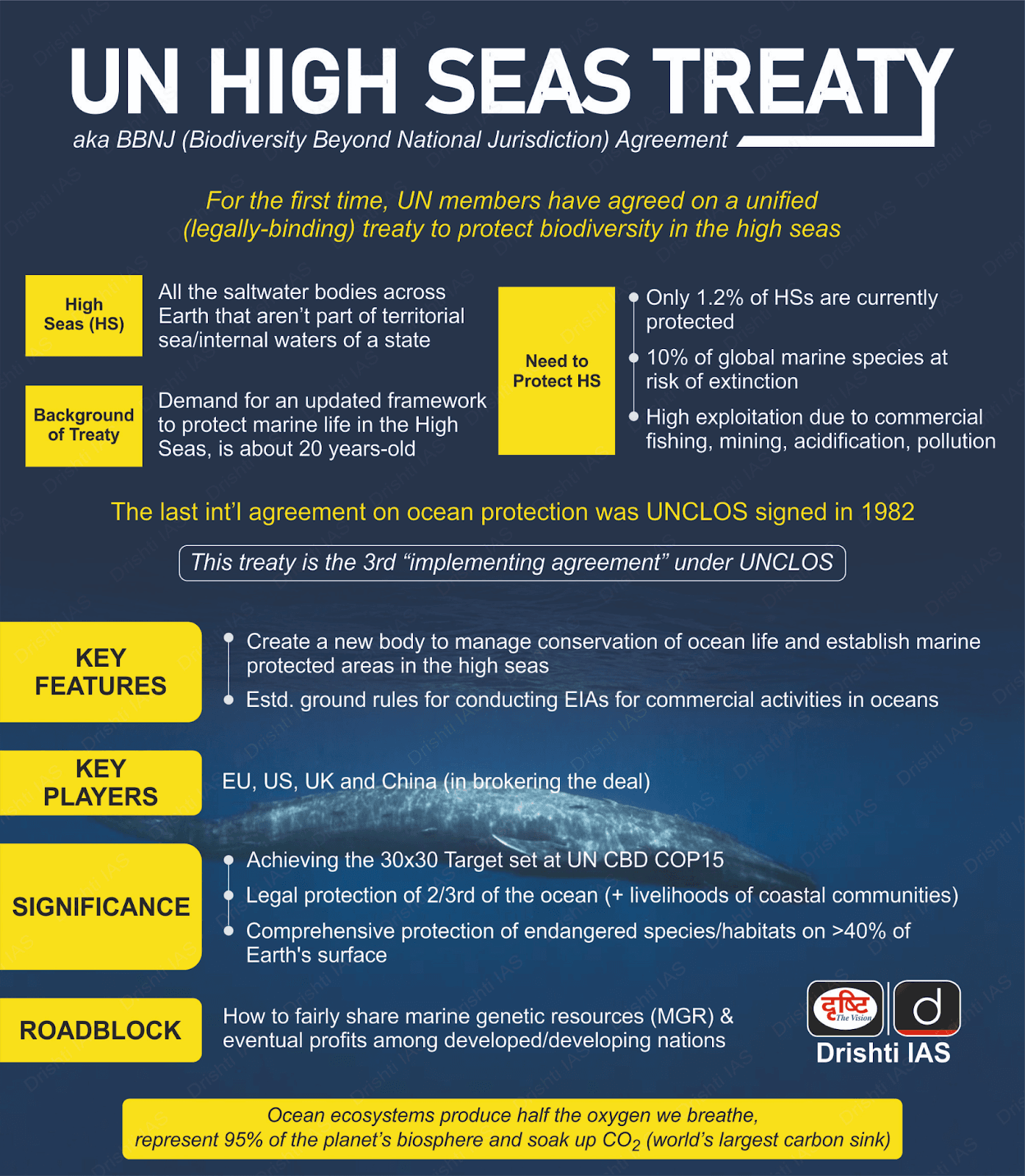
The High Seas Treaty, formally the Agreement under the United Nations Convention on the Law of the Sea on the Conservation and Sustainable Use of Marine Biological Diversity of Areas Beyond National Jurisdiction, will enter into force on 17 January 2026 after the required sixtieth instrument of ratification was deposited in 2025 and the treaty’s 120-day countdown elapsed. The accord establishes the first cohesive, legally binding international framework specifically aimed at the conservation and sustainable use of marine life beyond national jurisdiction.
Covering areas that account for nearly half of the planet’s surface and roughly two-thirds of the world’s oceans, the treaty creates new obligations on states to manage marine genetic resources, adopt area-based management tools including marine protected areas, conduct environmental impact assessments for high-seas activities, and provide capacity-building and transfer of marine technology. The Agreement also foresees a Clearing-House Mechanism to connect data, expertise and technology and to support equitable sharing of benefits from marine genetic resources.
The text was finalized during an intergovernmental conference on 4 March 2023 and formally adopted by negotiating states on 19 June 2023; it opened for signature on 20 September 2023 after nearly two decades of talks. Ratification moved steadily thereafter: Palau was reported as an early ratifier in January 2024, a cluster of 19 additional ratifications at the UN Third Ocean Conference in Nice in June 2025 raised the tally to 51, and Morocco deposited what multiple reports identify as the sixtieth instrument on 19 September 2025. Some reporting notes that Morocco and Sierra Leone were recorded the same day as the 60th and 61st parties; reported totals of signatories and parties vary by compilation, with IOC/UNESCO materials citing 145 signatories and 61 parties at the time of publication. The single clear legal trigger for entry into force was the sixtieth ratification and the subsequent 120-day period specified in article 68(1) of the Agreement.
Implementation will hinge on immediate institutional steps. A Preparatory Commission will convene to draft operational rules, establish governance bodies and operationalize the Clearing-House Mechanism. The IOC-UNESCO Assembly decided in June 2025 to create a Working Group on Biodiversity Beyond National Jurisdiction to advise the preparatory process. UN Secretary-General António Guterres called the milestone “a historic achievement for the ocean and for multilateralism,” urging countries to join and to implement the treaty swiftly. OceanCare cited Johannes Müller, Ocean Policy Specialist, describing the entry into force as “a historic day for the ocean,” while stressing the need to close governance gaps and set up effective management.

Market and policy implications will be wide-ranging. Fisheries regulators and the deep-sea mining industry face new layers of environmental assessment and area-based restrictions that could alter access and investment math in remote waters. Biotechnology and pharmaceutical firms that prospect marine genetic resources can expect governance mechanisms for benefit-sharing, potentially raising compliance costs but also clarifying legal risk. Conservation finance, capacity-building programs and regional governance arrangements are likely to expand as governments and funders seek to operationalize protections and meet global biodiversity targets such as the 30 percent by 2030 goal under the Kunming-Montreal framework.
With entry into force imminent, the most immediate challenge is translating treaty commitments into transparent, inclusive institutions that can marshal science, indigenous and local knowledge, and finance to manage the vast and biologically rich spaces of the high seas. Failure to do so would leave longstanding governance gaps intact; successful implementation could reshape ocean governance for decades.
Sources:
Know something we missed? Have a correction or additional information?
Submit a Tip