Massive Budapest March Demands Orbán Resign Over Juvenile Abuse
Tens of thousands took to the streets of Budapest on December 13 to protest footage of violence at a state juvenile detention centre, calling for Prime Minister Viktor Orbán to step down and for immediate reforms to child protection. The demonstration deepens pressure on the government ahead of spring elections, exposing institutional gaps in oversight and renewed civic mobilisation.

Tens of thousands of demonstrators gathered in central Budapest on December 13 to protest after the release of CCTV footage showing the then director of the Szolo Street juvenile detention centre kicking a detained boy. The opposition organised march amplified public outrage over the incident and the government response, combining vivid symbols such as soft toys and children’s items with political demands for Prime Minister Viktor Orbán to resign and for systemic reform of child protection.
Estimates of the crowd size vary. Reuters described the turnout broadly as thousands, while AFP, cited by a local outlet, put attendance at at least 50,000. The march was led by opposition figure Péter Magyar, also reported as Peter Magyar, who carried a banner reading Let’s protect children. Magyar’s TISZA party is reported to be leading opinion polls ahead of parliamentary elections scheduled for the spring, lending an immediate electoral dimension to the demonstrations.
The spark for the protest was the Szolo Street footage, which catalysed the detention of four staff members from the facility. The government responded by placing all juvenile detention facilities under police supervision, a move framed by officials as an immediate containment measure. Beyond those actions, reporting so far provides limited detail on formal charges, indictments, or disciplinary measures against named officials, a gap that protesters and analysts say underscores longstanding institutional weaknesses.
Public anger at the footage is entwined with broader dissatisfaction over how child protection has been handled during Viktor Orbán’s time in office. Since 2010 Orbán has publicly pledged to prioritise children, yet several high profile scandals and contested decisions have fed doubts about the effectiveness of oversight and accountability. The December 13 demonstration is being cast by activists and observers as part of a sustained movement that surged into the streets in 2024 after a presidential pardon in a child sexual abuse case and subsequent mass protests. Liberties.eu documented earlier large scale rallies on February 16 2024 and April 26 2024, with reported attendances ranging from tens of thousands to more than 100,000.
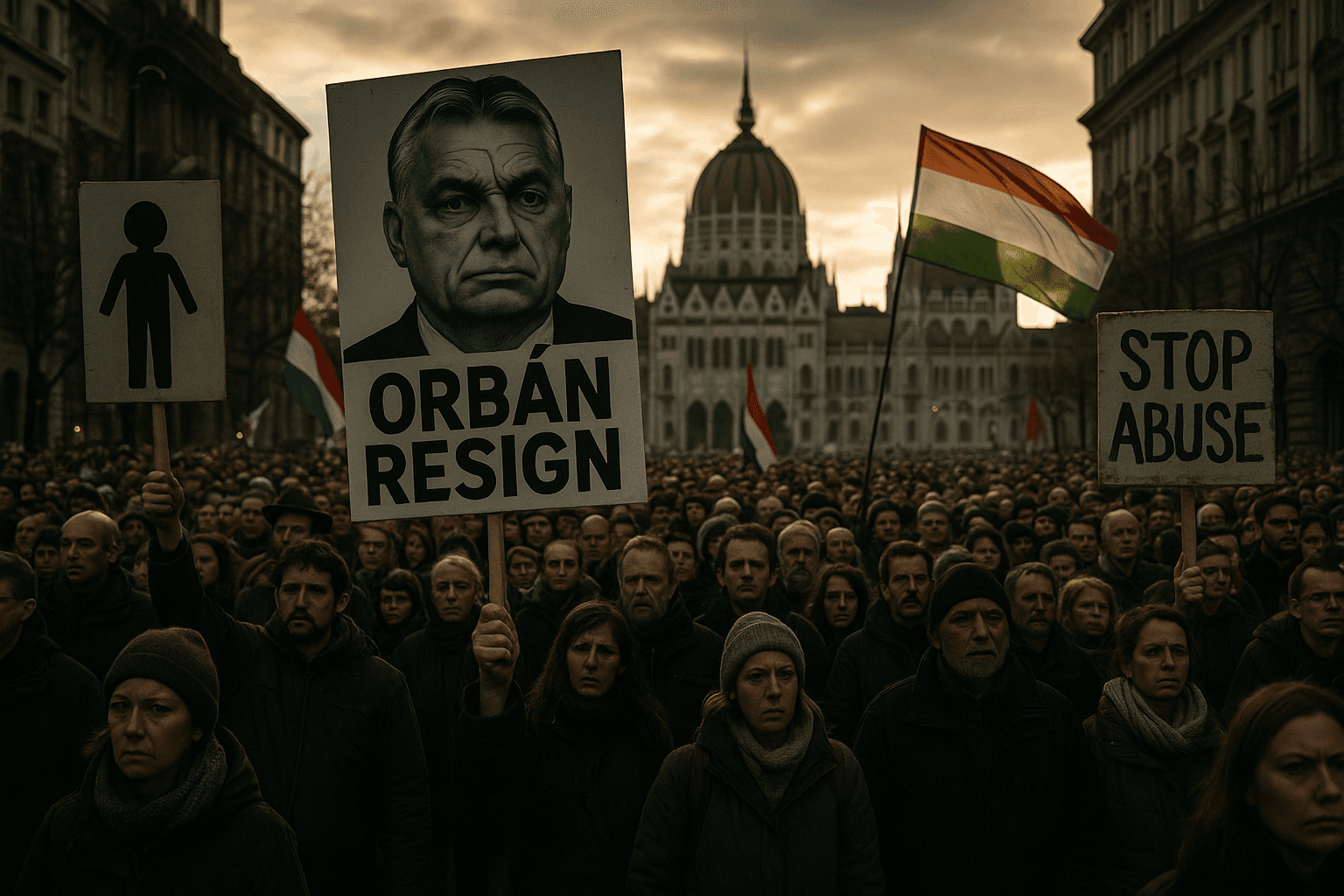
Voices on the march articulated a political as well as moral grievance. A 16 year old protester, David Kozak, told AFP, "Normally a government would be toppled after a case like this. For them the problem is not that the abuses happened, but that they were revealed." That sentiment captures the twin concerns driving the mobilisation, anger at the abuses themselves and at perceived official inaction or concealment.
Institutionally, the government’s decision to place centres under police supervision raises immediate questions about accountability, the division of oversight between child welfare agencies and law enforcement, and whether temporary measures will be followed by durable reforms. For voters, the episode crystallises competing narratives about competence and values as the country approaches a tightly contested electoral cycle. For civic actors, the demonstration demonstrates sustained capacity to translate outrage into organised pressure.
Key unanswered facts remain central to the public assessment of the case. Independent verification of the full scope of the footage, the specific charges against detained staff, the legal basis and terms of police supervision, and detailed official crowd figures will shape whether the protest translates into institutional change or becomes another episode in an ongoing cycle of controversy.
Know something we missed? Have a correction or additional information?
Submit a Tip
%2Fi.s3.glbimg.com%2Fv1%2FAUTH_da025474c0c44edd99332dddb09cabe8%2Finternal_photos%2Fbs%2F2025%2FK%2Fk%2FyrBrW1ScatAE4lj5somA%2F54719297810-53f7e85105-c-1-.jpg&w=1920&q=75)
