Museveni seeks seventh term as succession and stability concerns rise
Museveni aims for a seventh term as January-February elections approach, intensifying questions over succession, military influence and democratic backsliding.

Veteran President Yoweri Kaguta Museveni, who has governed Uganda since 1986, is widely expected to run for a seventh consecutive term in the general elections scheduled from 15 January to 6 February 2026. His decision to pursue another four years has sharpened debate not only over electoral integrity but over how power will be transferred in a country where state institutions and the military remain tightly interwoven.
Museveni was nominated in July 2025 as the sole candidate of the ruling National Resistance Movement, a move that cemented his path to the ballot after constitutional changes removed term and age limits. Now in his early 80s, he has argued that another term would allow him to "protect the gains" he credits with bringing relative peace and stability to Uganda, a line that continues to resonate with older voters and many officials who emphasize continuity.
The most prominent challenger is Robert Kyagulanyi, better known as Bobi Wine, a 43-year-old pop star-turned-politician who finished with roughly 35 percent of the vote in the 2021 presidential contest. Bobi Wine, also identified by his given name Kagulani Sentamu, has galvanized younger Ugandans angered by unemployment, corruption and limited prospects, turning youthful disaffection into a persistent political force despite a fragmented opposition landscape that has struggled to consolidate behind a single alternative.
Much of the election’s significance, however, centres on succession. Museveni’s son, Muhoozi Kainerugaba, a senior military commander with an expansive social media presence and an active role in promotions and the creation of new army departments, looms over the contest despite not being a candidate. Muhoozi is widely viewed as a favored eventual successor, and has publicly expressed a desire to lead. The personality cult that has accrued around him has found visible expression in campaign paraphernalia and public discourse; at one point the speaker of Parliament described him as "God the Son," a characterization that struck many Ugandans and international observers as emblematic of the personalization of power.
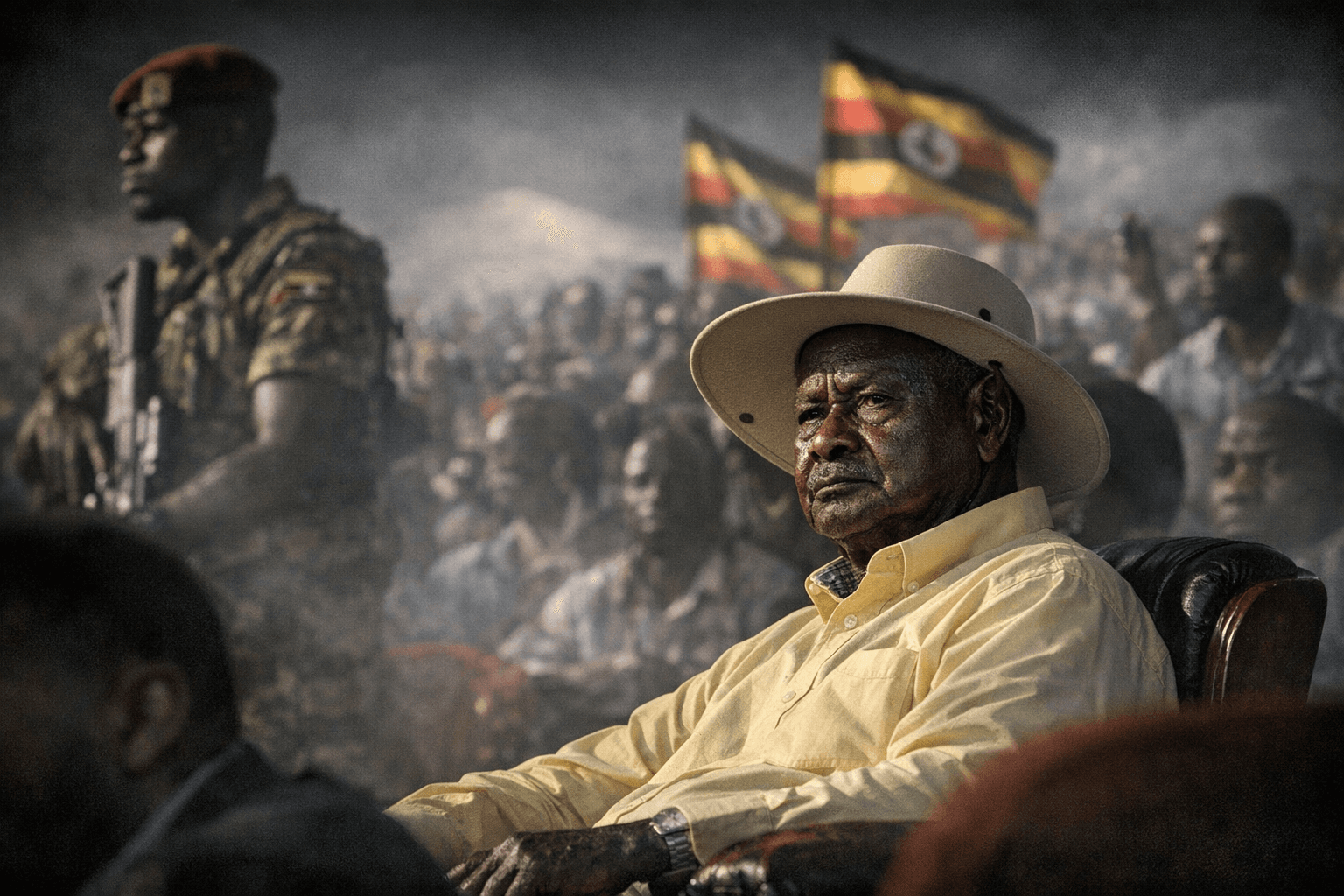
The United Nations human rights office has warned that the 2026 vote is taking place amid an eroding rule-of-law environment, urging the government to ensure freedoms of assembly, association, expression and press. Independent observers and analysts report a climate of harassment and repression: tear gas, beatings, mass arrests, arbitrary detentions and at least three deaths linked to opposition events have been documented, raising alarm about the space available for campaigning and peaceful dissent. Many analysts describe the tactics of the state as an intensification of competitive authoritarianism, using institutional capture to constrain rivals, media and civil society.
Economically, the government points to potential gains from forthcoming oil production as a factor that could reshape Uganda’s growth trajectory during a next term. Critics counter that resource wealth without strengthened governance risks deepening corruption and inequality, and that control of security institutions will determine the contours of any transition.
As the country moves into its voting window, international actors and local rights groups are pressing for measures to reduce violence, guarantee transparent processes and hold security forces to account. Whether the election produces an accepted result or a further consolidation of power will have consequences not only for Uganda’s democratic trajectory but for stability and governance across the East African region.
Know something we missed? Have a correction or additional information?
Submit a Tip

