Seoul launches probe after Pyongyang says South Korean drones breached airspace
South Korea opens a joint military-police investigation after North Korea says it shot down drones; the outcome could shape fragile inter‑Korean ties and regional stability.

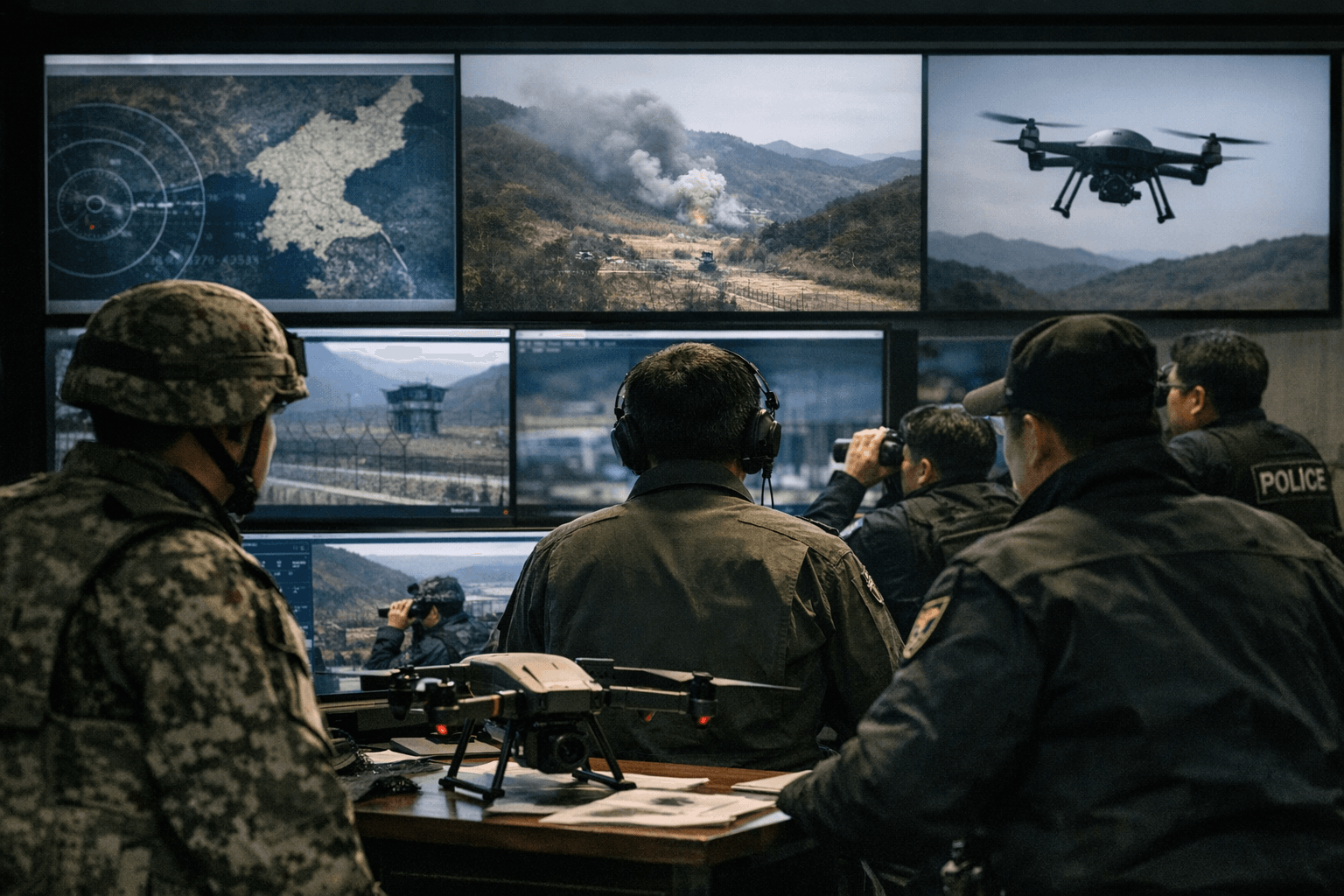
South Korea has opened a joint military-police investigation after North Korea published images and debris it says came from drones that crossed into its airspace and were shot down. The probe, ordered by President Lee Jae Myung, is intended to establish facts and to calm an already tense relationship on the peninsula.
President Lee has instructed authorities to carry out a "swift and rigorous" inquiry and warned that, if the allegations are true, such drone flights would amount to "a serious crime that threatens peace on the Korean Peninsula and national security." Seoul's Defense Ministry framed the investigation as a combined military-police effort aimed at determining whether any laws were violated and at demonstrating that the government had no intention of military provocation.
A task force of roughly 30 personnel has been assembled to examine flight logs, radar data and any physical evidence that can be obtained domestically. Seoul's military has publicly denied that the Korea Armed Forces operated the aircraft at the times cited by Pyongyang, saying it did not "possess the unmanned aerial vehicle in question, nor did it operate any unmanned aerial vehicles at the time and date specified by North Korea." The ministry has not confirmed whether the drones, if they originated in the South, were launched by civic activists, private groups or state actors; investigators say ownership and control remain key open questions.
Pyongyang has posted images and fragments it says are debris from downed drones and has accused the South of similar incursions on two earlier occasions, in September 2025 and on Jan. 4, 2026. Those claims have not been independently verified. North Korea's public disclosures are likely aimed at signaling deterrence domestically and to regional audiences, while complicating Seoul's diplomatic options.
Defense Minister Ahn Gyu-back said he was considering proposing a joint inter-Korean investigation, potentially coordinated through the U.N. Command, though Seoul has not formally offered such a probe to Pyongyang. The U.N. Command declined to comment when asked whether it would investigate. Analysts say North Korea is unlikely to accept a South Korean request for a joint inquiry, a dynamic that reduces the prospects that the episode will open a channel for dialogue.
The incident arrives against a backdrop of persistent "gray-zone" friction. Pyongyang deployed trash-carrying balloons into the South in 2024 and in late 2023 declared the two Koreas to be hostile states, moves that have frayed trust and complicated Seoul's outreach. President Lee's administration has signaled a desire to improve ties and has proposed military talks, but Pyongyang has not reciprocated.
For Seoul, the immediate imperative is to complete a credible, transparent domestic investigation that can either rebut Pyongyang's allegations or identify the responsible parties and the degree of official complicity, if any. How South Korea handles the findings will have diplomatic consequences across the region, shaping Washington's posture, Tokyo's calculations and what little room remains for inter-Korean engagement.
Investigators say technical analysis and possible forensics on any recovered parts will take time. In the absence of cooperation from the North, confidence in any cross-border conclusion will be limited, leaving the episode as another test of crisis management on a volatile peninsula.
Sources:
Know something we missed? Have a correction or additional information?
Submit a Tip

