Portable Water‑Testing Project Brings Pathogen Labs To Buckhorn Students
University of Kentucky researchers and collaborators visited Buckhorn School in December to train about 25 high school volunteers on a portable "lab on a chip" water‑testing device and to test samples from nearby Squabble Creek. The hands‑on work, part of a larger NSF surveillance and pandemic‑preparation effort, aims to expand local capacity for faster, on‑site pathogen monitoring and to give Perry County students career exposure in science and public health.
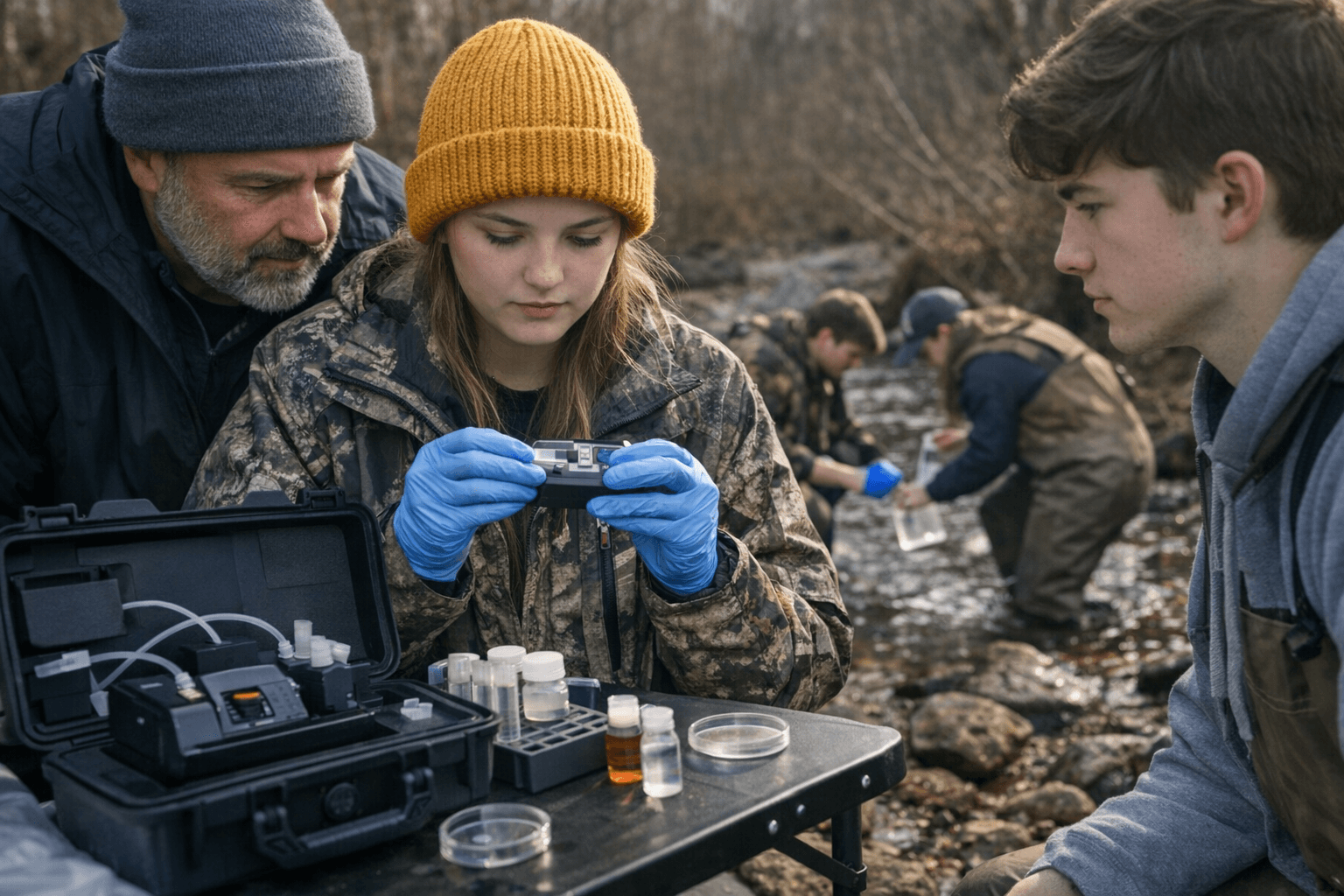
University of Kentucky researchers, joined by teams from Arizona State University, the University of Alaska Anchorage and the Wildlife Conservation Society, worked with Buckhorn High School students in December to demonstrate a portable "lab on a chip" water‑testing device developed at UK. About 25 students volunteered to collect and analyze water samples from Squabble Creek as part of the NSF Environmental Surveillance Center for Assessing Pathogen Emergence, known as ESCAPE, which is tied to a broader NSF Predictive Intelligence for Pandemic Preparation award led by UK and partners.
The device produces on‑site pathogen testing results, a capability university engineers described as a way to reduce dependence on distant laboratories and to expand monitoring access in under‑resourced communities. For Perry County, where laboratory access and sample transport can add time and expense to routine water testing, the portable system offers potential for quicker local detection of contamination and faster community response.
Buckhorn was chosen for the visit because Squabble Creek is a local water resource with a documented history of water‑system issues and because the community experienced significant impacts from the 2022 Eastern Kentucky floods. Local educators and project staff said bringing testing capabilities into the school setting reinforces public‑health resilience by building local technical skills and awareness. Teachers at Buckhorn plan to incorporate follow‑up discussions and lab protocols into classwork so the practical experience can inform curricula and possible career pathways.
Beyond immediate classroom benefits, the project dovetails with broader economic and public‑health objectives. Localized testing can shorten turnaround times that otherwise require shipping samples to distant facilities, lowering operational friction for routine monitoring and emergency response. That reduced friction may translate into cost savings for small utilities and households and diminish the economic disruption that follows waterborne outbreaks or flood‑related contamination events.
The December visit also served as workforce development: students gained exposure to engineering and public‑health research practices that can feed local talent pipelines into STEM fields. As ESCAPE proceeds, researchers and educators in Perry County will be able to assess whether portable testing can be scaled for sustained community monitoring and integrated into school‑based science programs, strengthening both public health safeguards and economic resilience in this Appalachian county.
Sources:
Know something we missed? Have a correction or additional information?
Submit a Tip