PSLV-C62 launches EOS-N1 and 15 co-passengers with re-entry demo
ISRO's PSLV-C62 lifts off carrying EOS-N1 and 15 co-passengers, including a Spanish re-entry demonstrator. The flight underscores a return to rhythm for India's workhorse launcher.
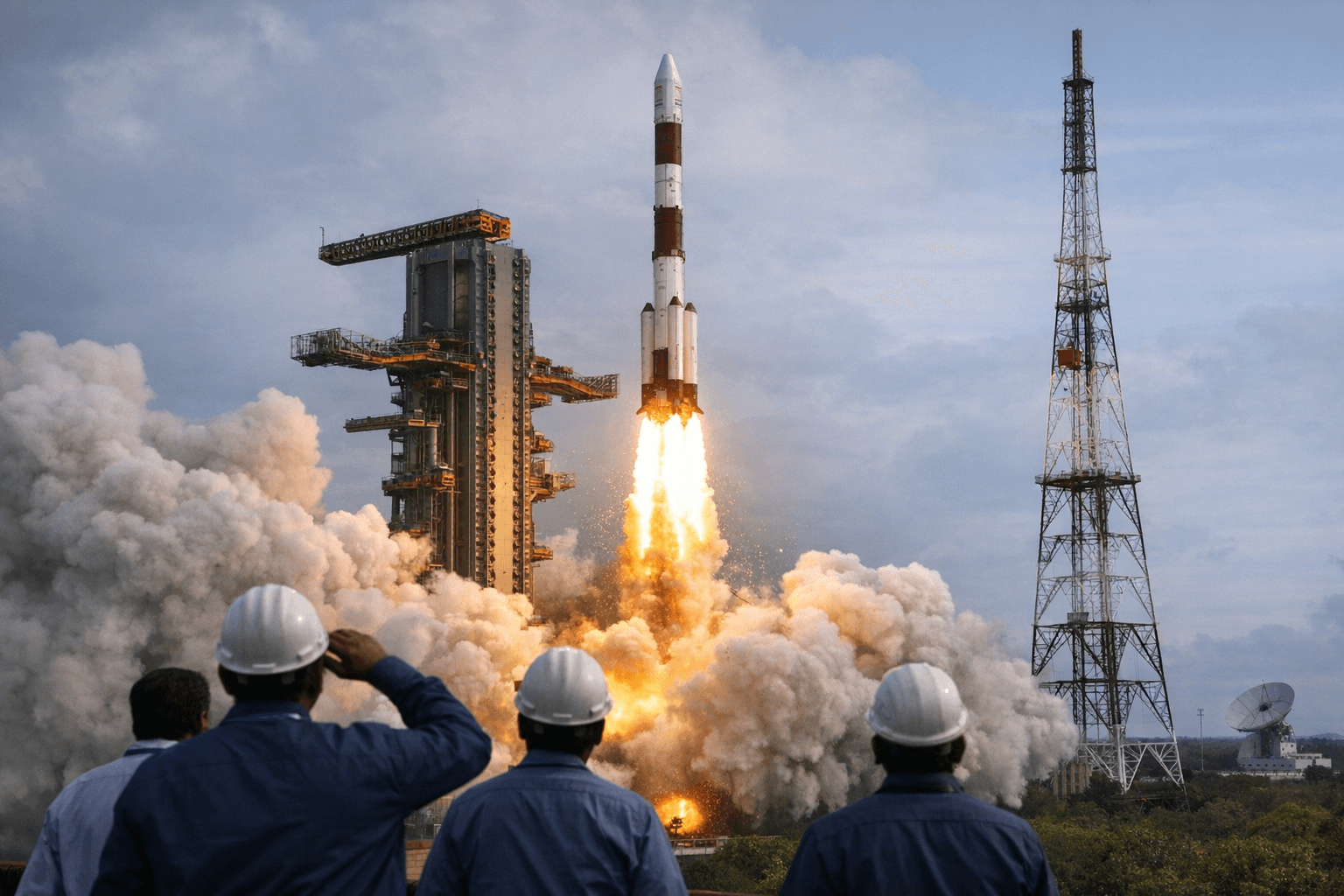
A Polar Satellite Launch Vehicle carrying an international Earth observation satellite and a cluster of small payloads lifts off from the First Launch Pad at Satish Dhawan Space Centre, Sriharikota, in a mission that blends commercial rideshare work with a re-entry technology test.
ISRO begins an automated 22.5-hour countdown on January 11 at about 12:48 pm IST and lifts off the PSLV-C62 around 10:17 to 10:18:30 IST on January 12. The vehicle is the PSLV-DL variant, a four-stage launcher with two solid strap-on motors, listed at roughly 260 tonnes and 44.4 metres in height. ISRO counts this flight as the 64th in the PSLV family, and NewSpace India Ltd describes the operation as its ninth dedicated commercial mission supporting the primary customer payload.
The principal satellite on board is EOS-N1, also called Anvesha, an Earth observation platform developed through collaboration between Thailand and the United Kingdom for international customers. NSIL is handling commercial arrangements for the launch and the co-passenger manifest. ISRO and NSIL documentation list 15 co-passenger payloads on the flight; mission materials identify the Kestrel Initial Demonstrator, or KID, a small re-entry vehicle from a Spanish startup, as a distinct technology demonstrator included among the ride-share.
Orbital insertion places the primary and secondary payloads into a sun-synchronous polar orbit, with mission updates indicating an insertion altitude near 505 kilometres and an inclination close to 97.5 degrees. Deployment is sequenced to inject EOS-N1 first, followed by the remaining co-passenger satellites over roughly the next 17 minutes. The flight plan extends beyond initial deployments: the PS4 fourth stage is scheduled for an in-orbit restart more than two hours after liftoff to perform a controlled deboost and to set up a re-entry trajectory for the KID capsule. That capsule is to separate and descend for splashdown in the South Pacific Ocean under a controlled re-entry test.
The rideshare manifest reflects a diversity of small-satellite applications and technology demonstrations. Payloads include experiments for on-board artificial intelligence processing, store-and-forward communications, Internet of Things services, radiation monitoring, agricultural data services and other small-satellite capabilities increasingly in demand for both commercial and scientific customers. The inclusion of an active re-entry demonstrator signals growing interest in return-to-Earth technology for recovery and downstream services.
The flight arrives after a setback in May 2025 when a PSLV mission failed to place a satellite into its intended orbit because of a third-stage anomaly. PSLV-C62's successful sequencing of deployments and the PS4 re-entry demonstration are being viewed by officials as restoring momentum to the PSLV program and reinforcing ISRO's commercial launch credentials.
Pre-launch integration and checks were completed in the days before liftoff, and mission activity from launch through stage restarts and re-entry maneuvers unfolds as a marathon operation that spans roughly 108 minutes of orbital and de-orbit activity. For ISRO and its commercial arm, the mission underscores both the PSLV's continued role as a reliable workhorse for small and medium payloads and the growing market for tailored in-orbit demonstrations and rideshare services.
Sources:
Know something we missed? Have a correction or additional information?
Submit a Tip