Russian Ban on Roblox Spurs Rare Protest in Tomsk
Several dozen people gathered in Tomsk on December 14 to protest the Russian government’s block of the U.S. based gaming platform Roblox, a rare public display of dissent over internet restrictions. The demonstration has deepened debate inside Russia about censorship, child safety and whether bans actually protect children or simply drive users to circumvention tools.

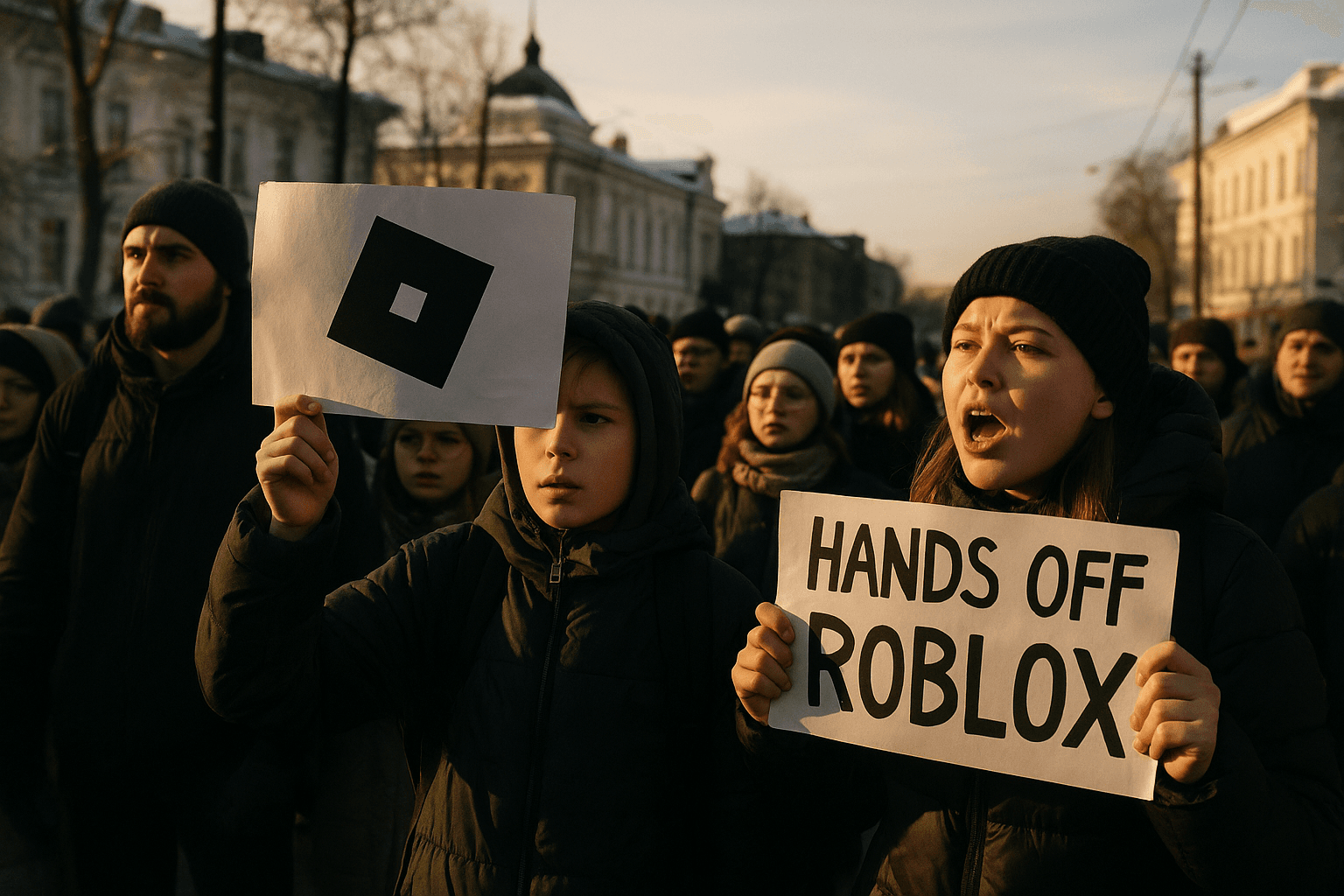
Several dozen people gathered in Vladimir Vysotsky Park in Tomsk on December 14 to protest the government ban on the children focused gaming platform Roblox, carrying hand drawn placards that read "Hands off Roblox" and "Roblox is the victim of the digital Iron Curtain." The demonstration was notable both for its rarity and for the sharp split it highlighted within Russian public opinion over state control of online spaces.
The ban was imposed on December 3 by the communications watchdog Roskomnadzor, which said the platform was "rife with inappropriate content that can negatively impact the spiritual and moral development of children." Roskomnadzor framed the action as a protective measure for youth and moral development, asserting that restrictions were necessary to shield minors from harmful material.
Roblox Corporation, which is headquartered in San Mateo, California, responded by underscoring its approach to moderation and safety, saying the company has "a deep commitment to safety." The company has in recent years invested in content moderation tools and age tailored experiences, but regulators and parents remain sharply divided over whether those measures are sufficient.
The Tomsk protest crystallized that division. Some parents and teachers have expressed support for the ban, saying they worry that the open nature of the platform can expose children to sexual content and to unsupervised interactions with adults. Others, including the demonstrators in Tomsk, called the ban overbroad and symbolic, arguing that technical blocks can be easily circumvented with virtual private networks and that no broadly used Russian alternative exists to absorb the platform’s young audience.
The confrontation over Roblox fits within a wider international pattern. Several other countries have temporarily or permanently restricted the platform in response to safety concerns, and Russia’s move is the latest instance of authorities using content regulation to shape digital childhoods. Within Russia the case has prompted a broader discussion about the limits of state intervention in online life and about whether prohibition or stricter platform engagement better protects children.
Experts and civil society actors say key questions remain unanswered. Regulators have not publicly released detailed evidence showing the scope and prevalence of the allegedly harmful content on Roblox inside Russia. Meanwhile technical analysts note that bans often create patchwork enforcement, with access varying by internet provider and users circumventing restrictions through commonly available tools.
The protest in Tomsk was small by historical standards, yet its appearance matters because public demonstrations over internet policy are uncommon in Russia. For some observers the gathering signals a latent frustration among parents and younger internet users who feel cut off from global platforms. For others it is a reminder that attempts to close online spaces are likely to provoke debates that extend beyond immediate questions of child safety to questions of censorship, digital literacy and who sets the rules for children’s online lives.
The outcome of the dispute remains uncertain. Russian authorities are likely to press their case for a protective rationale, while platform operators and rights advocates will continue to press for transparency about both the evidence for bans and the technical means of enforcement. The Tomsk protest made clear that the conversation is now playing out not only in regulatory filings but in public squares.
Know something we missed? Have a correction or additional information?
Submit a Tip