Sheinbaum urges U.N. to prevent bloodshed after U.S. oil blockade order
Mexican President Claudia Sheinbaum on Wednesday called on the United Nations to intervene to prevent violence in Venezuela after the United States ordered a blockade of sanctioned oil tankers, a move that has heightened regional tensions. Her appeal frames Mexico as a mediator seeking de‑escalation, while reported U.S. force movements and Caracas’s sharp denunciation underscore the risk of wider confrontation.

President Claudia Sheinbaum on Wednesday publicly urged the United Nations to step in to prevent violence in Venezuela, pressing the international body to "fulfil its role" after the United States announced measures to block sanctioned oil tankers from entering and leaving Venezuelan waters. Speaking at her morning news conference in Mexico City, she reiterated Mexico’s opposition to intervention and foreign interference and offered Mexican facilities as a venue for negotiations should both parties agree.
"I call on the United Nations to fulfil its role. It has not been present. It must assume its role to prevent any bloodshed," Sheinbaum said, adding that "we call for dialogue and peace, not intervention." Her comments came a day after President Donald Trump ordered what the White House described as a "blockade" of all sanctioned oil tankers tied to Venezuela, a step that Caracas condemned as unacceptable.
Venezuelan President Nicolás Maduro’s government immediately labeled the move a "grotesque threat" and rejected the blockade and associated U.S. actions. At the same time, the United States has repositioned forces to the region, including thousands of troops and nearly a dozen warships, including an aircraft carrier, a posture that officials say is intended to deter escalation even as it has alarmed regional capitals.
Brazilian President Luiz Inácio Lula da Silva has also weighed in, offering to help mediate and saying he is "concerned about Latin America" and about Trump’s "attitudes toward Latin America." Lula told Mr. Trump that patient, substantive talks are needed, and he has repeated offers to host or facilitate dialogue between Washington and Caracas if both sides consent.
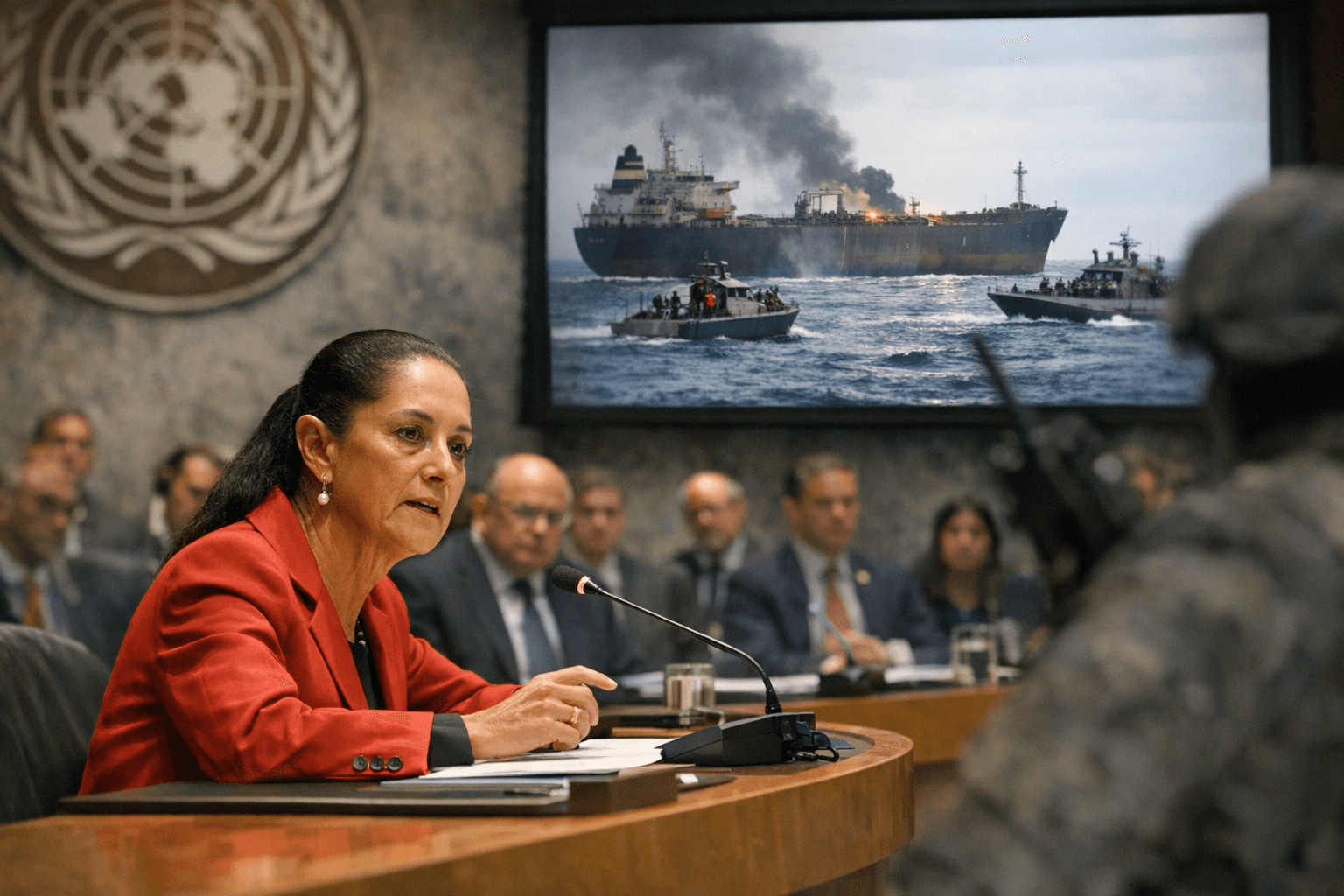
Sheinbaum’s intervention places Mexico in a delicate diplomatic position. Historically noninterventionist, Mexico has nonetheless sought an active diplomatic role in recent years, balancing ties with the United States and regional solidarity with Latin American governments wary of external pressure. By publicly calling on the U.N., Sheinbaum is signaling that Mexico views the situation as one that should be handled multilaterally rather than by unilateral coercive measures.
The legal and practical implications of a blockade raise complex questions under international law and maritime norms, and the presence of U.S. forces increases the risk that a miscalculation could spiral. The United Nations Security Council faces limitations in responding, given the politics of vetoes and competing geopolitical interests, while regional bodies will confront the challenge of forging a unified diplomatic front.
For now, the immediate outlook depends on whether Washington and Caracas accept offers of mediation and whether the U.N. will take concrete steps to convene talks. Sheinbaum’s appeal for the U.N. to prevent bloodshed is a clear call for diplomacy, but the next days will test whether regional leaders and the major powers can translate that plea into tangible de‑escalation and negotiated engagement.
Know something we missed? Have a correction or additional information?
Submit a Tip

