UMD Places 31 Scholars on International Highly Cited Researchers List
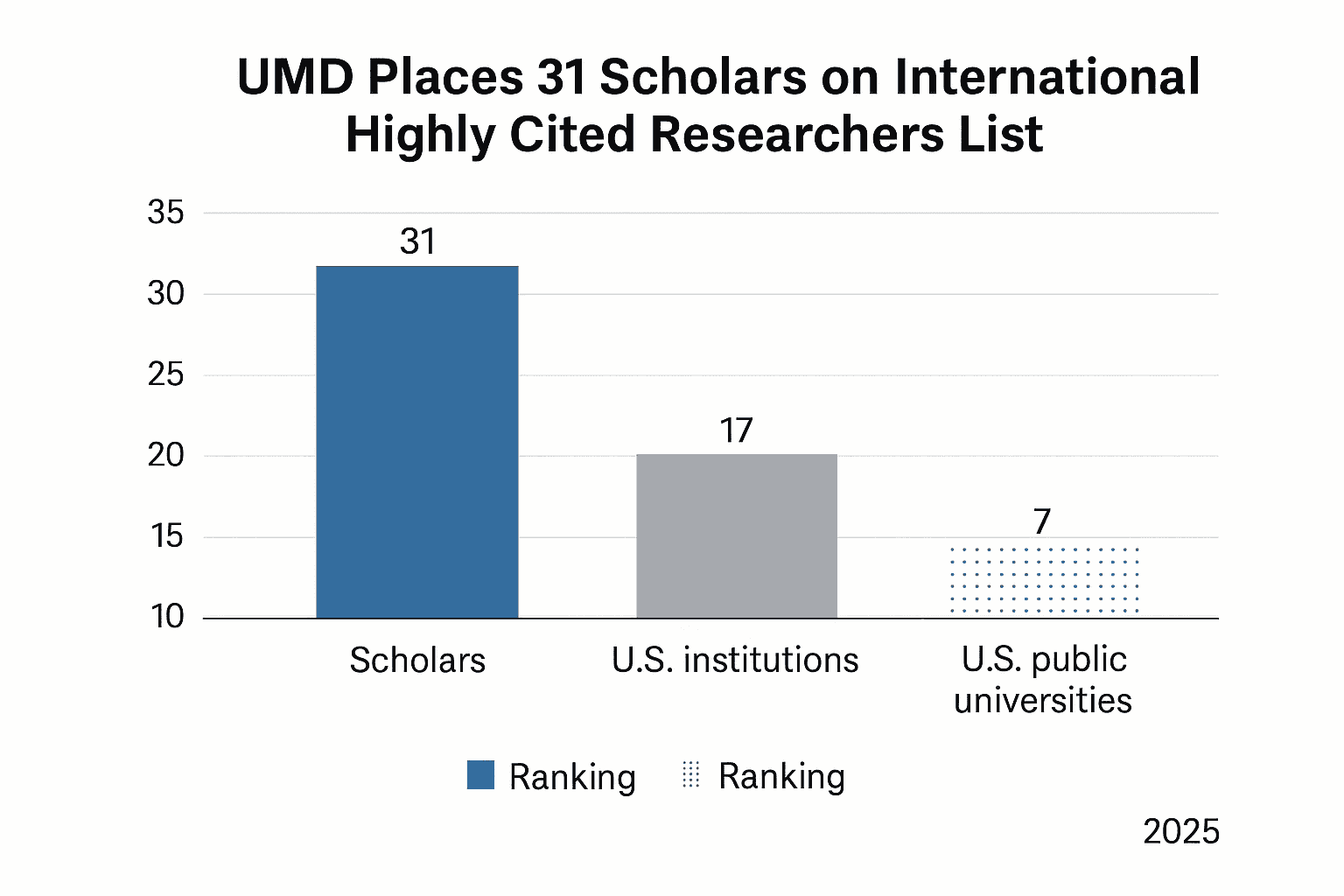
On December 4, 2025 the University of Maryland announced that 31 of its scholars were named to Clarivate’s 2025 Highly Cited Researchers list, placing UMD among the top 20 institutions in the United States by that metric. The designation highlights UMD research that is frequently cited by peers, a recognition that has implications for federal funding competitiveness, local economic development, and county university partnerships.

On December 4, 2025 the University of Maryland released a list naming 31 faculty and researchers to Clarivate’s 2025 Highly Cited Researchers roster, a measure that places the university at number 17 among U.S. institutions and number 7 among U.S. public universities. Clarivate’s list is an international benchmark that identifies scholars whose publications are most frequently cited by their peers, and the inclusion of 31 names signals concentrated influence across multiple research fields at UMD.
The recognition serves as an institutional indicator of research impact rather than a direct grant or budgetary award. Nevertheless, highly cited status is commonly used by federal agencies, private foundations, and corporate partners as one factor when evaluating proposals, collaborations, and funding priorities. For a county that hosts a major public research university the ranking strengthens UMD’s case in competitive grant applications and in negotiating public private partnerships that can bring investment and jobs to Prince George’s County.

Locally the designation can support workforce development and economic development strategies. Universities with a critical mass of highly cited researchers typically attract graduate students, postdoctoral fellows, and research oriented firms. That flow of talent and activity often leads to increased demand for lab space, incubation services, and specialized support from local government in areas such as zoning, transportation, and broadband infrastructure. County leaders who aim to grow a technology and research economy may find new leverage from UMD’s enhanced research profile when pursuing state and federal resources.
The recognition also has civic significance. Highly cited research can inform county policy on public health, environmental resilience, transportation, and education. Strengthening formal channels for translating university research into county decision making could improve evidence based policy and expand internship and training pathways for local residents. As UMD’s research profile continues to grow, elected officials and county administrators will face choices about how to align local investments to capture the economic and policy benefits that stem from a research intensive anchor institution.
Sources:
Know something we missed? Have a correction or additional information?
Submit a Tip