Albany County posts lowest unemployment in Wyoming at 2.9%
State labor data released January 9, 2026 show Albany County's seasonally adjusted unemployment rate held steady at 2.9% in November 2025, the lowest among Wyoming counties. The statewide rate fell slightly to 3.4% while national unemployment stood at 4.6%, a pattern that signals a tight local labor market with implications for wages, housing, and workforce policy.
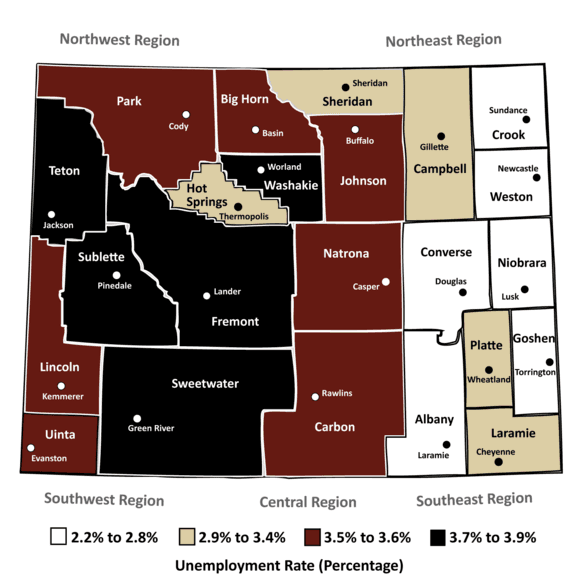
The Research & Planning section of the Wyoming Department of Workforce Services reported on January 9 that Albany County recorded the lowest seasonally adjusted unemployment rate in the state in November 2025, unchanged at 2.9% from the same month a year earlier. Wyoming’s overall unemployment rate was 3.4% in November 2025, down from 3.6% in November 2024 and below the U.S. rate of 4.6% for the month.
County-level trends were mixed across Wyoming from November 2024 to November 2025. Unemployment rates rose in 16 counties, fell in four, and held steady in three. The largest county increases occurred in Niobrara, Sweetwater and Weston counties, while rates declined in Sheridan, Johnson, Sublette and Hot Springs counties. Alongside Albany, Goshen and Uinta counties saw no change, registering 3.6% and 3.8% respectively.
The release also included total nonfarm employment estimates and flagged a disruption in household survey data collection for October 2025 caused by a lapse in federal funding. That interruption complicates month-to-month comparisons because household survey continuity is central to calculating unemployment and labor force participation. Analysts and policymakers should therefore interpret short-run movements with caution while relying on broader seasonal and multi-month trends for decision making.
For Albany County residents and employers, a 2.9% unemployment rate indicates a tight labor market. Economically, sustained low unemployment tends to push up wages as employers compete for a limited pool of workers, which can help household incomes but also raises labor costs for businesses. Those wage pressures, combined with limited housing supply, can contribute to higher living costs and create recruitment challenges for local firms and public services.

From a policy perspective, the data underline the importance of workforce development and housing strategies. Local officials may need to prioritize training programs that expand the candidate pool and consider incentives for housing development to ease recruitment bottlenecks. At the state level, the small decline in Wyoming’s unemployment rate relative to the national average suggests modest labor market strength, but the county-level divergence highlights structural differences tied to regional industries and demographic shifts.
Looking ahead, maintaining reliable survey data will be essential for tracking whether Albany’s low unemployment represents a durable trend or a short-term fluctuation. For now, the county’s jobless rate is a relative strength in a state where labor market performance varies noticeably from county to county.
Sources:
Know something we missed? Have a correction or additional information?
Submit a Tip