Dilbert creator Scott Adams dead at 68, leaves a conflicted legacy
Scott Adams, creator of Dilbert, died at 68. His passing ends a divisive, influential career that reshaped workplace satire and ignited cultural debates.

Scott Adams, the cartoonist whose strip Dilbert became shorthand for corporate absurdity, died at 68, his ex-wife Shelly Miles announced during a livestream on Jan. 13. The news spread through Adams’ own video channels and members of his online community; he had publicly disclosed an aggressive metastatic prostate cancer diagnosis in May 2025 and had been livestreaming until days before his death. Adams left a New Year’s Day written statement that was posted after his death, portions of which read, "I had an amazing life. I gave it everything I had. If I get any benefits from my work, I’m asking that you pay it forward as best as you can. That’s the legacy I want. Be useful, and please know, I loved you all to the very end." Reports also include his closing expression of faith: "I accept Jesus Christ as my lord and savior and I look forward to spending an eternity with him."
Adams forged one of the defining comic voices of the 1990s with Dilbert, a satirical take on white collar culture that ran in newspapers around the world and entered corporate lexicons with terms and characters that captured cubicle-era anxieties. He parlayed that popularity into business and self-help books, including How to Fail at Almost Everything and Still Win Big and Win Bigly, and cultivated a public persona that blended management advice, persuasion theory and social commentary.
That persona became polarizing in the 2010s and 2020s. A shift in Adams’ public commentary culminated in February 2023 when remarks he made about Black Americans on his livestream provoked widespread condemnation. Within days, hundreds of newspapers stopped carrying Dilbert and his distributor, Andrews McMeel Universal, announced it would no longer work with him. Adams responded by taking his work directly to readers, relaunching the strip in a self-published subscription format as Dilbert Reborn on his site and subscription platforms. He continued producing content for paying subscribers even as the traditional syndication model unraveled around him.
Industry observers say Adams’ trajectory underscores deep changes in the media economy. His de-syndication highlighted how newspapers and distributors weigh reputational and commercial risks, while his transition to a direct-to-consumer model illustrated how creators can monetize niche audiences even after mainstream channels shutter. At the same time, the dispute exposed the vulnerabilities facing legacy comics and the newspapers that relied on them as inexpensive, high-engagement content.
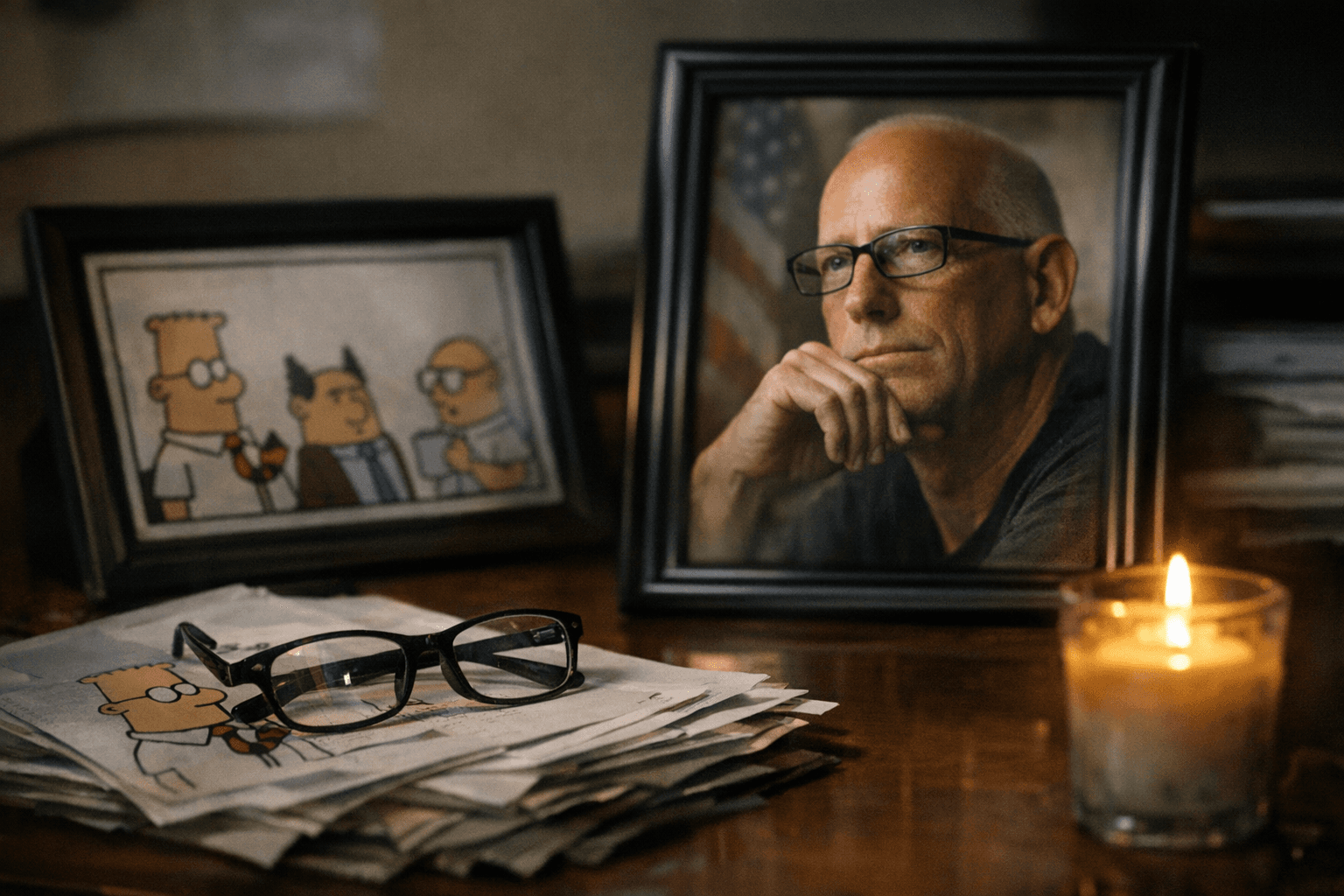
Culturally, Adams embodied the tension between authorial voice and public consequence. For decades his cartoons gave millions a way to laugh at office life; in later years his platform amplified controversial views that many found beyond the bounds of acceptable public discourse. The resulting fracturing around his work prompts broader questions about how societies preserve shared cultural artifacts when their creators become divisive figures, and about the balance between free expression and institutional response.
In his final months Adams stopped drawing the strip after reporting cramping and partial paralysis in his hands in November 2025, though he continued to write and publish. He spent much of his career in the Bay Area, and he will be remembered as both a defining satirist of the corporate age and a flashpoint in debates over speech, accountability and the changing business of media.
Know something we missed? Have a correction or additional information?
Submit a Tip