German Foreign Minister Presses China on Rare Earths, Steel
Germany's foreign minister is in Beijing to press Chinese leaders on trade restrictions that affect critical supply chains, with a focus on rare earths, semiconductors, electric vehicle components and steel. The visit signals Berlin's effort to reconcile deep economic ties with security concerns, and to enlist Beijing's influence in stabilizing the conflict in Ukraine.

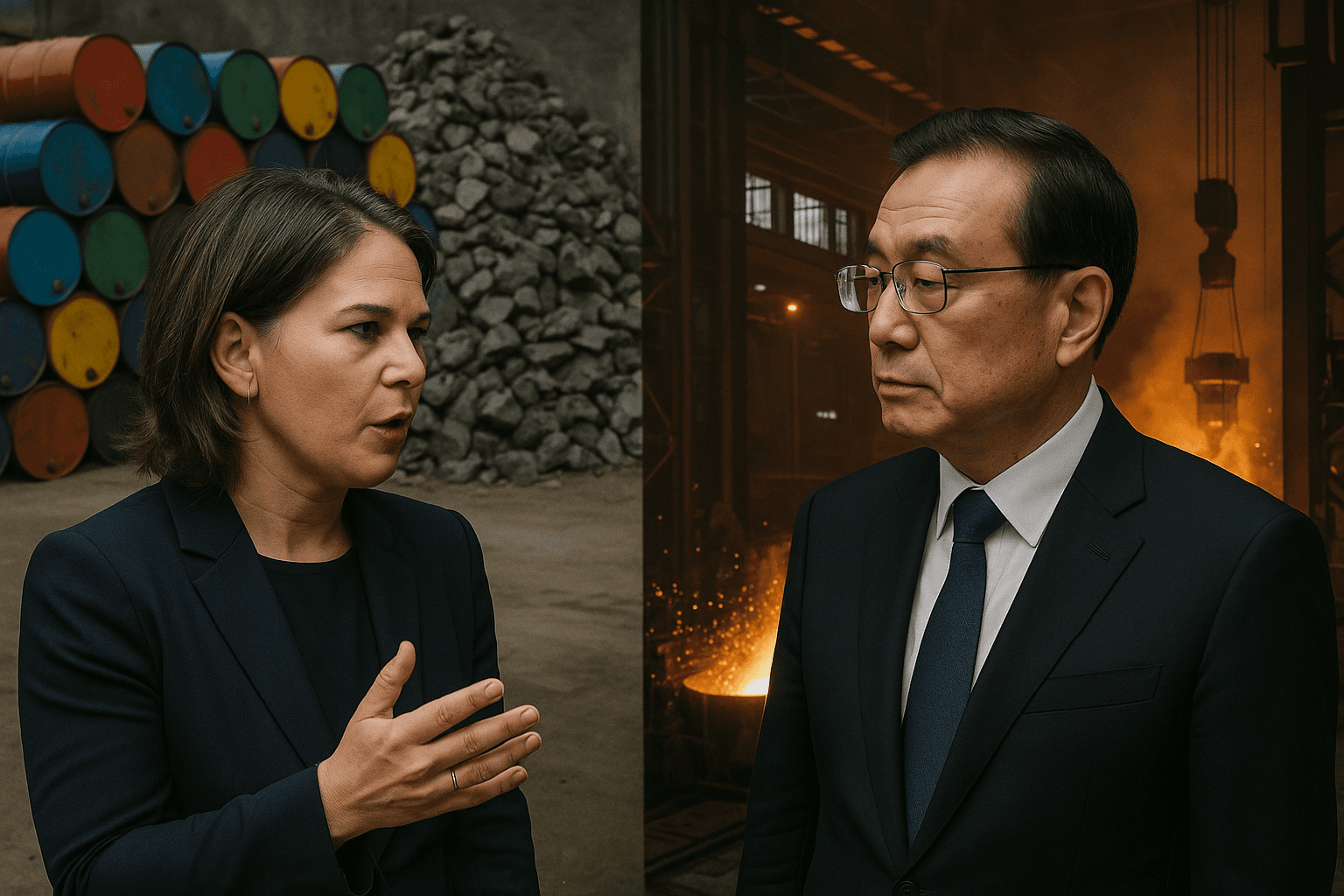
Germany's foreign minister Johann Wadephul is in Beijing on December 7 to press China on a suite of strategic trade issues that have become central to European industrial policy. Officials said Wadephul will raise restrictions affecting minerals and semiconductor inputs, challenge global overcapacity in electric vehicle components and steel, and urge China to use its leverage to help stabilize the situation in Ukraine.
The trip comes at a moment of intensifying scrutiny in Europe of supply chain vulnerabilities. China produces roughly half of the world's crude steel output and controls the vast majority of rare earth processing capacity, a combination that gives Beijing outsized influence over industries from construction to high tech. European manufacturers, and Germany's export oriented economy in particular, rely on secure access to those materials and to advanced semiconductors for everything from cars to defence systems.
Market participants are watching closely. Any hint of tighter Chinese export controls or retaliatory trade measures could quickly affect commodity prices and industrial margins. Rare earth prices have been volatile in recent years as buyers seek alternatives to concentrated supply, and Europe has accelerated efforts to diversify sources of minerals and to increase recycling capacity for permanent magnets and batteries. At the same time, persistent overcapacity in steel and some electric vehicle components has depressed prices globally and intensified calls in Brussels for trade defence measures.
Berlin's approach on the visit is pragmatic. Germany remains economically interdependent with China, which is its largest trading partner for goods, yet policymakers are increasingly prepared to couple engagement with safeguards. The German government has strengthened foreign investment screening, expanded strategic stockpiles for certain inputs, and supported EU moves to develop domestic production of critical components through subsidies and public private partnerships. Wadephul's mission underscores a broader strategic shift toward reducing acute dependencies while preserving market access where possible.
Policy implications extend beyond bilateral tensions. Coordinated EU responses could include trade remedy cases, cooperation with like minded partners on critical minerals, and investment in semiconductor fabrication and research. Such moves aim to blunt supply shocks but carry costs. Building capacity in Europe takes time and capital, and producers will face a transition period in which global markets remain influential.
The Ukraine dimension adds a geopolitical layer. Berlin is pressing Beijing to use diplomatic influence to reduce the intensity of the conflict and to support stabilization efforts. For Germany, keeping China engaged on security and economic fronts is part of a dual track policy that seeks to avoid outright decoupling while defending strategic national interests.
Wadephul's visit will test how much economic interdependence can be preserved amid rising strategic competition. The outcome will shape industry planning and market expectations for months to come, particularly in sectors that hinge on a handful of materials and components controlled largely outside Europe.
%3Amax_bytes(150000)%3Astrip_icc()%2F100901867_soybeans-60844bfb2b68432a8447f18fa34d28b5.jpg&w=1920&q=75)