India Advances Ghatak Stealth UCAV Toward Prototype Flight in 2025-26
India’s Defence Research and Development Organisation has pushed forward development of Ghatak, an indigenous stealth unmanned combat aerial vehicle, with demonstrator flights and program milestones that suggest a first full prototype could fly in 2025-26. The project underscores New Delhi’s drive for military self-reliance while raising questions about timelines, propulsion choices and operational readiness.
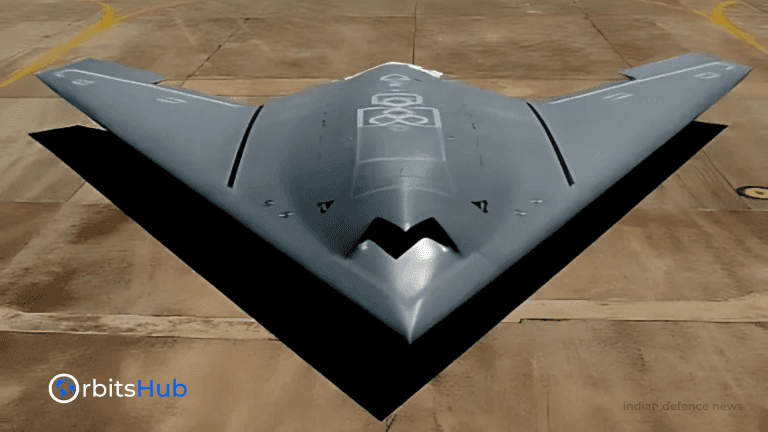
India’s classified Ghatak program, an indigenous jet-powered stealth unmanned combat aerial vehicle intended for the Indian Air Force, has moved through a visible demonstrator phase and is now being positioned for full-scale fabrication and prototype testing in the near term. Sanctioned in 2016 with initial funding reported at roughly ₹70 crore (about ₹101 crore or US$12 million in 2023 equivalent), the program has been developed under names including AURA and IUSAV and overseen by the Defence Research and Development Organisation.
The Aeronautical Development Establishment in Bengaluru is listed as the primary development and test agency, with the Aeronautical Development Agency credited for design work and the Indian Institute of Technology, Kanpur linked to early research and flying-wing concepts. Public reporting traces the program’s transition from early concept to demonstrator stage beginning in 2020 with the Stealth Wing Flying Testbed, or SWiFT, a scaled technology demonstrator. Open sources and DRDO communications indicate a first scaled flight occurred in July 2022 and that multiple follow-on demonstrator flights have taken place, with the programme described as having reached medium maturity after a series of successful tests.
Design claims circulating in public reporting portray Ghatak as a flying-wing configuration built for reduced radar cross-section and internal carriage of missiles and precision-guided munitions. The airframe is frequently cited at a gross weight near 13,000 kilograms and described as a high-subsonic system with cruise speeds in the 950 to 1,100 km/h range. Demonstrator aircraft have appeared with large landing gear, external test aerials and sensor fairings, consistent with developmental flight-testing rather than final operational fit.
Propulsion remains a key uncertainty. Multiple sources report early prototypes may use an interim Russian turbofan, while indigenous ambition centers on a Kaveri-derived engine. Parliamentary remarks from 2015 indicated a dry Kaveri variant of about 52 kN thrust, and separate reporting references a GTX-35VS Kaveri variant near 48 kN with planned thrust-vector-control development. Some analysts expect a transition to an indigenous Kaveri powerplant only by the mid-2030s.
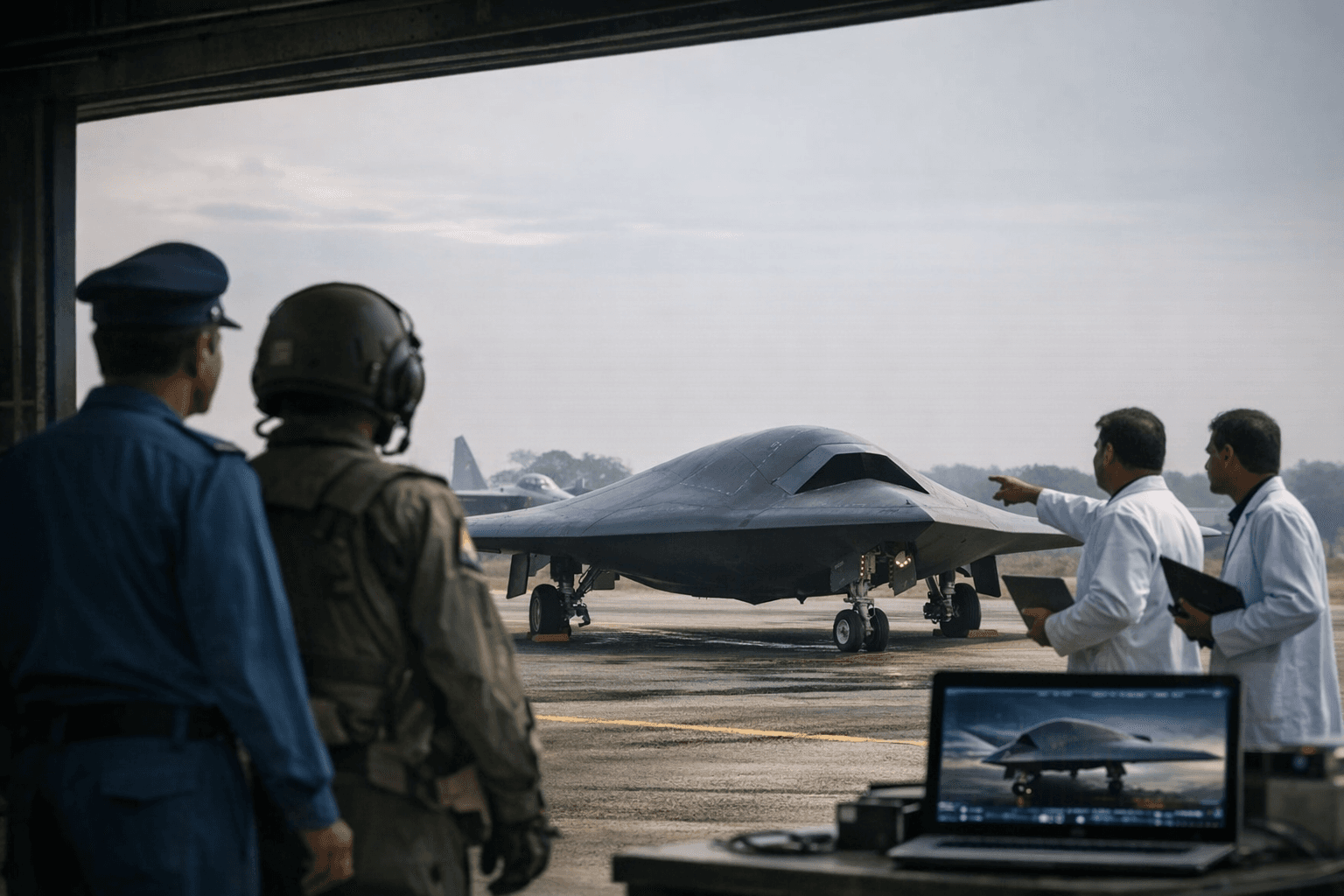
Other capability claims in open reporting include radar-absorbent material testing at a southern facility, network-centric datalinks with satellite connectivity, electro-optical sensors, likely electronic-warfare suites and aspirations for autonomous long-range flight with automated weapons release from an internal bay. The classified status of the project leaves endurance, exact sensor fits, weapons loadouts and operational concepts publicly unverified.
Programmatic and governance questions have accompanied technical progress. Reporting in 2024 flagged concerns after work shifted from ADA, with its established record, to ADE, prompting scrutiny of institutional roles and delivery risk. Full-scale fabrication in Bengaluru was planned for 2024 but was deferred; the consolidated public view heading into 2026 places a first full prototype flight in 2025-26 and potential IAF introduction around 2030, though timelines remain fluid.
Ghatak sits at the intersection of India’s Aatmanirbharta self-reliance drive and evolving autonomous strike doctrines. If realized, it would aim to reduce reliance on foreign platforms and field a domestic stealth strike asset for contested airspace, but significant technical, governance and funding hurdles must be cleared before that capability becomes operational.
Sources:
Know something we missed? Have a correction or additional information?
Submit a Tip