Justice Department Charges Two Over Alleged Smuggling of Nvidia Chips
The U.S. Justice Department on December 9 charged two men accused of running a scheme to export Nvidia H100 and H200 AI GPUs to China in violation of federal export controls. Prosecutors say the operation used straw purchasers, mislabeling and U.S. warehouses to move at least $160 million worth of restricted chips, a step officials called a national security threat.

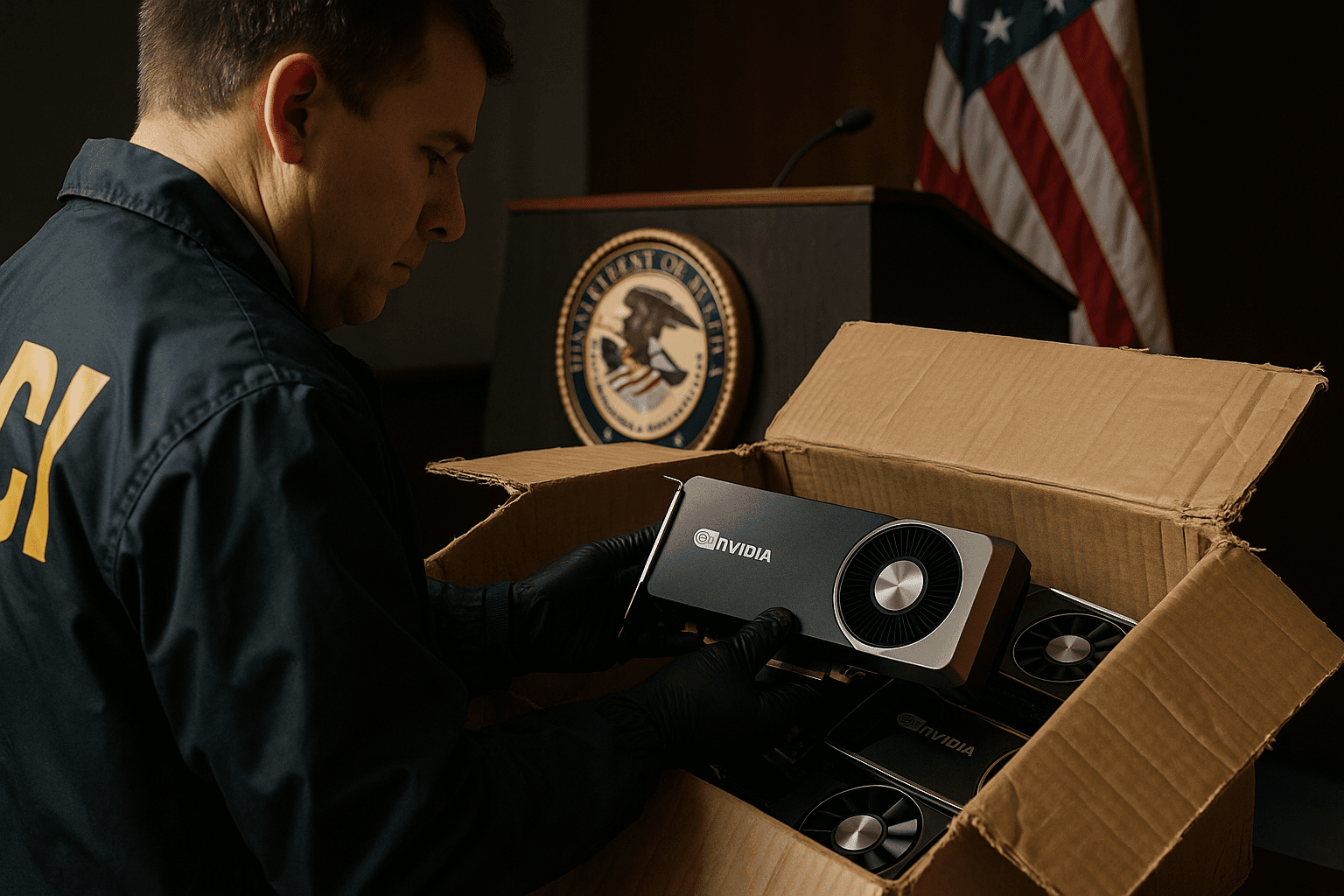
The Justice Department announced criminal charges on December 9 against two men accused of participating in a years long scheme to smuggle advanced Nvidia H100 and H200 artificial intelligence graphics processing units to China in violation of U.S. export controls. Prosecutors allege the network, active since at least November 2023, relied on straw purchasers, removal of serial and brand labels, and routing through U.S. based warehouses to conceal the true destination of restricted chips.
According to the complaint filed by federal prosecutors, shipments linked to the conspiracy included tens of millions of dollars in high performance AI hardware. Prosecutors estimate that at least $160 million worth of chips were exported or attempted to be exported as part of a wider scheme that has spawned earlier prosecutions and guilty pleas in the same investigation. The U.S. attorney leading the case described the alleged effort as a national security threat to the United States.
The H100 and H200 GPUs are among the most capable commercially available accelerators for training large scale machine learning models. Since 2022 and 2023 the U.S. government has imposed controls that restrict exports of these and similar chips to China without a license, citing concerns that the hardware could be used by foreign military programs or advanced surveillance systems. The Justice Department indictment frames the alleged smuggling as a deliberate attempt to evade those controls by obfuscating ownership, altering identifying labels, and using third party shipment points in the United States.
Investigators say the charged defendants formed part of a broader network that used shell purchases and intermediary companies to acquire stock from distributors and then conceal its true origin and destination. The complaint alleges that serial numbers and brand markings were removed from chip units before they were packed and shipped, making them harder to trace. U.S. warehouses were used as temporary holding sites and points of re packaging prior to onward export.
The case follows a string of enforcement actions aimed at securing the semiconductor supply chain and enforcing export bans that analysts say are central to Washington efforts to slow the transfer of cutting edge AI capabilities to geopolitical competitors. Prosecutors connected the newly filed charges to prior guilty pleas in the same operation, signaling that the investigation has been expansive and that authorities have been unraveling multiple links in a commercial network tied to transnational sales.
Legal experts say the prosecution underscores both the importance and the difficulty of policing a global technology market where high value components can be routed through multiple jurisdictions and intermediaries. Companies that supply and ship advanced chips face increased scrutiny, and compliance teams are likely to intensify efforts to verify end users and maintain audit trails of serial and brand level information.
The Justice Department action is likely to reinvigorate congressional and regulatory debates about how to tighten controls on critical technology exports while minimizing unintended harm to legitimate commerce and scientific collaboration. For now the charges mark a high profile example of enforcement against what prosecutors say is a calculated effort to move restricted AI hardware to China.
Sources:
Know something we missed? Have a correction or additional information?
Submit a Tip