Kimball War Memorial Symbolizes McDowell County's Black Heritage and Loss
The Kimball War Memorial, dedicated in 1928 and among the nation’s earliest monuments to Black World War I veterans, stands as a physical record of McDowell County’s vibrant African American community and its subsequent decline. Once a social and cultural hub that housed one of the country’s first all-Black American Legion posts and hosted performers such as Cab Calloway, the Classical Revival building now faces disrepair amid the loss of mining jobs and long-term population decline.

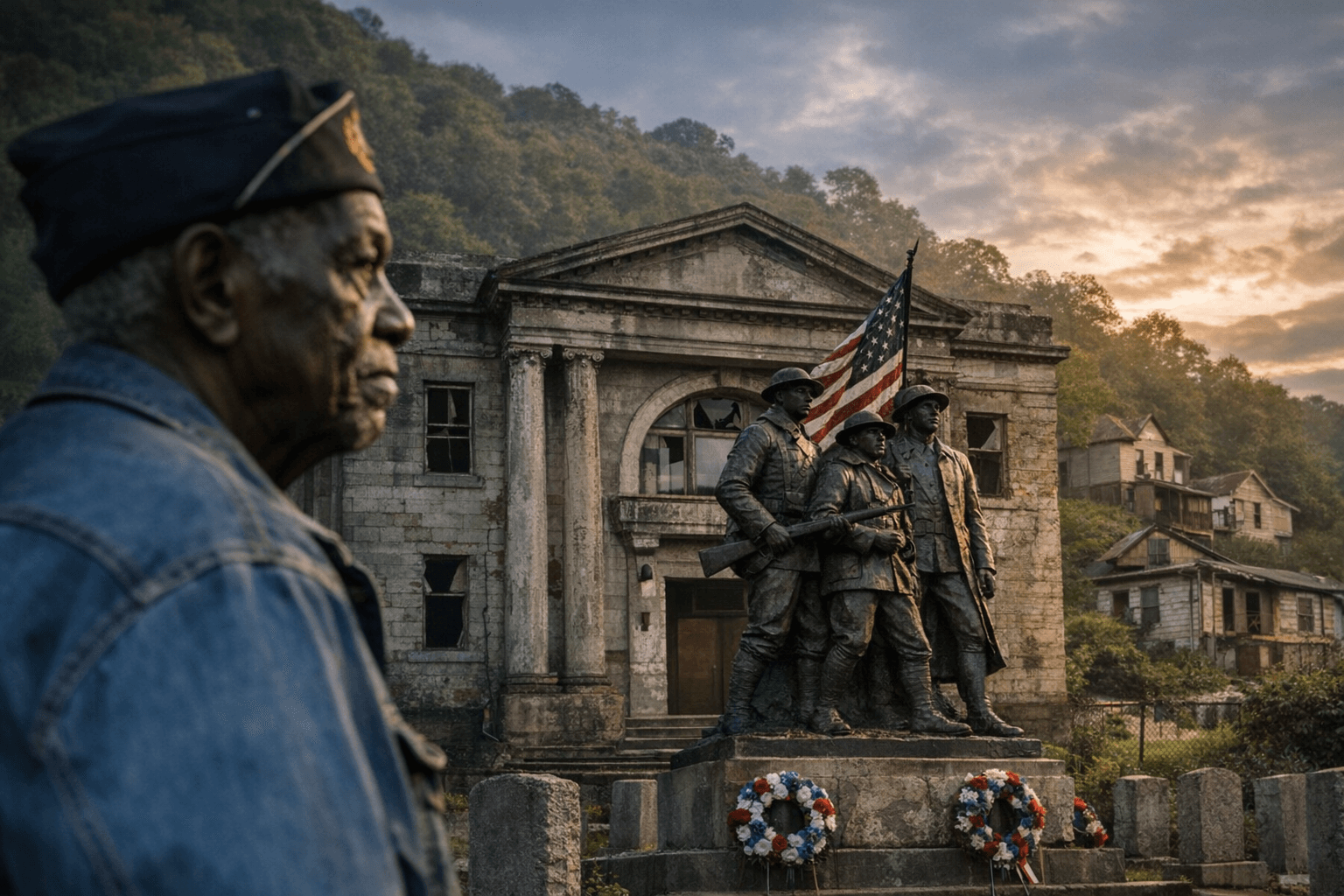
The redbrick Kimball War Memorial occupies a prominent place in the history of Kimball and the broader McDowell County coalfield. Designed by Hassel T. Hicks of Welch and dedicated in 1928, the two-story Classical Revival structure is marked by a massive two-story Roman Doric portico. It was erected specifically to honor Black veterans of World War I at a time when few public monuments recognized their service.
Beyond its commemorative function, the building became a center of community life. It housed one of the country’s first all-Black American Legion posts, named for Luther Patterson, and served as a gathering place for veterans, families and social organizations. The auditorium and meeting spaces drew nationally known entertainers, including Cab Calloway, underscoring the role the memorial played as a cultural anchor in the coalfield era.
The memorial’s history tracks closely with McDowell County’s economic arc. During the early and mid-20th century, coal mining supported dense, ethnically diverse communities and funded civic institutions. As mining jobs left the region and the county’s population declined, that economic base eroded. The Kimball War Memorial, like many public buildings designed for a larger, wealthier community, gradually fell into disrepair as financial resources for maintenance and restoration dwindled.
That deterioration carries practical and symbolic consequences for local residents. Physically, a neglected landmark can suffer accelerating damage that raises eventual restoration costs. Culturally, loss of the memorial would mean the disappearance of one of the few built reminders of Black veterans’ service and the social life they sustained in McDowell County. Preservation advocates point to the building’s architectural significance and its unique role as both a memorial and social center as reasons to prioritize stabilization and restoration.
Reviving the memorial, however, faces familiar constraints: limited local tax revenue, competition for grant funding, and the logistical costs of rehabilitating a large historic structure. Any effort would likely require a mix of private donations, state or federal preservation grants, and partnerships with historical organizations or veteran groups. Restored, the building could serve as a focal point for heritage tourism and community programming that reconnects residents with the county’s multiethnic past.
The Kimball War Memorial stands at the intersection of architecture, military commemoration and community memory. Its survival will depend on whether local leaders, preservationists and potential funders see value in investing in a site that tells a distinctive story about Black service, social life and the economic transformations that reshaped McDowell County.
Sources:
Know something we missed? Have a correction or additional information?
Submit a Tip