Longstanding Bowhead Contaminant Study Shows Declines, Guides Local Subsistence Safety
The North Slope Borough Department of Wildlife Management continues an ongoing Bowhead Whale Contaminant & Nutrient Study that monitors persistent organic pollutants and nutrient levels in subsistence-harvested bowhead whales. Findings show many contaminant classes have fallen substantially since the 1990s, information that directly informs community subsistence guidance, wildlife management, and public health planning across North Slope communities.
The North Slope Borough Department of Wildlife Management maintains a standing scientific and public health resource tracking contaminants and nutrients in bowhead whales taken in local subsistence hunts. The program, led by principal investigators in partnership with the National Oceanic and Atmospheric Administration and supported by State of Alaska funding, samples tissues from subsistence-harvested whales to measure persistent organic pollutants, or POPs, and nutrient content. These measurements help officials balance food safety with protection of cultural and nutritional practices that sustain Arctic communities.
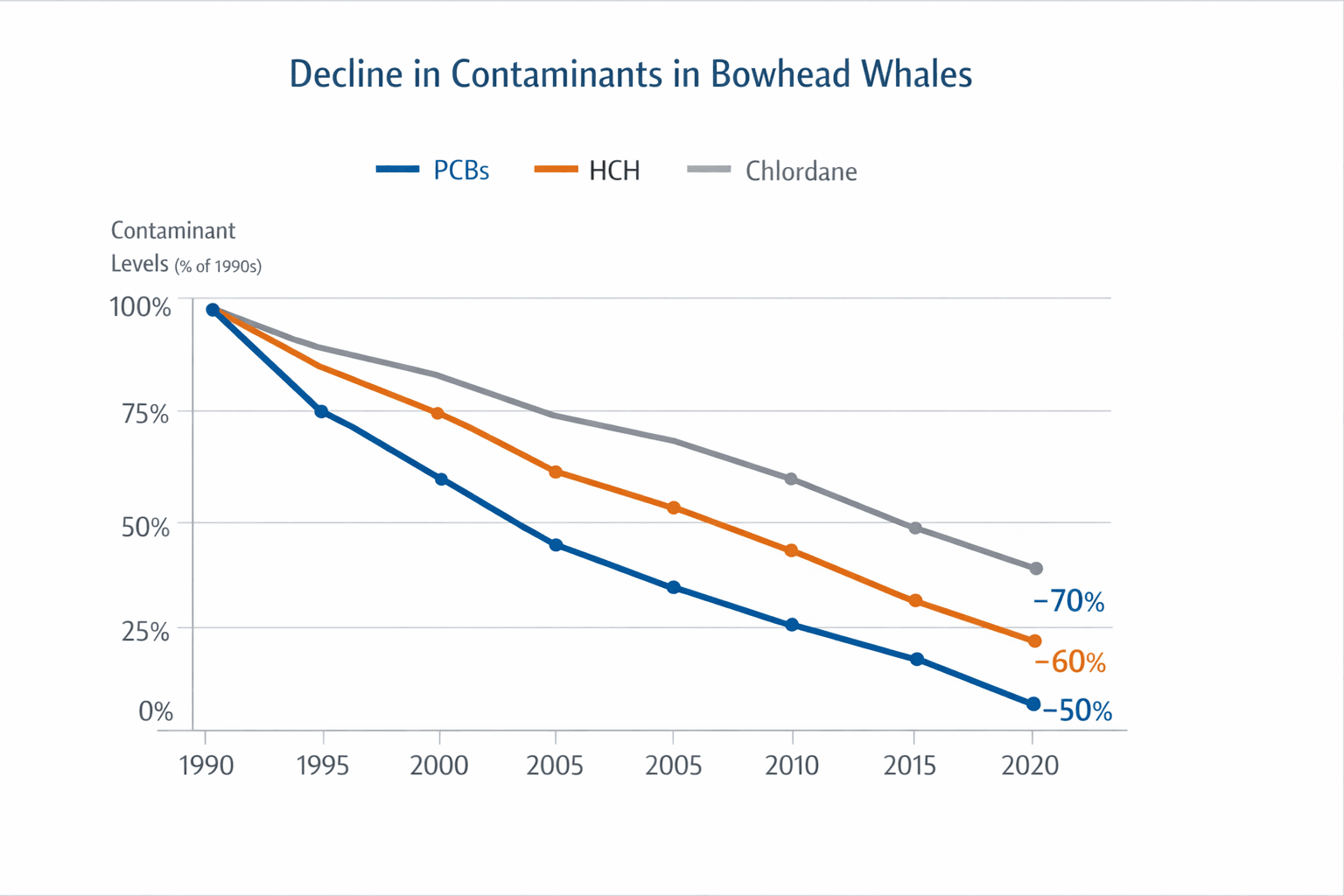
Summary findings published by the borough show many classes of contaminants in bowhead tissues have declined substantially since monitoring began in the 1990s. In some instances levels are reported at one-half to one-quarter of earlier measurements. Investigators attribute those long-term declines in part to international controls on POPs such as measures under the Stockholm Convention, while underscoring the need for continued local monitoring.
For residents of the North Slope Borough, those trends matter in practical ways. Contaminant and nutrient data feed subsistence guidance and community outreach so hunters and households can make informed choices about sharing and preparing meat and blubber. The study also supports long-term wildlife management by tracking whale health indicators that affect population assessments and harvest planning.
Public health implications remain significant despite positive trends. POPs are bioaccumulative and can concentrate in marine mammals, so ongoing surveillance is necessary to protect groups at higher risk from exposure, including pregnant people, nursing parents, and young children. Monitoring allows health officials to tailor messaging that preserves access to traditional foods while minimizing exposure risks.
The study also raises equity and policy questions that extend beyond laboratory results. Subsistence hunting is central to food security, cultural identity, and community resilience for Alaska Native populations on the North Slope. Continued federal and state support for monitoring programs ensures that communities not only receive data but also participate in shaping how results are communicated and applied. Long-term funding and collaborative research frameworks help address the disproportionate burden these communities face from contaminant transport and environmental change that originates far beyond the Arctic.
As the borough continues this work, its contaminant and nutrient dataset serves as both a scientific record and a management tool—linking global chemical policy outcomes to local health, cultural continuity, and stewardship of bowhead whales.
Sources:
Know something we missed? Have a correction or additional information?
Submit a Tip