Three fast AM developments reshape traceability, repairs, and ice printing
Three industry items surfaced today that matter for practitioners and labs: Hamburg startup amsight secures strategic investment to scale data-driven quality management and boost GS1 traceability standards for regulated additive manufacturing. NAVAIR additive teams enabled a cross-service rapid repair at Kadena Air Base by 3D-printing and installing an F-15 cockpit cooling duct in under 12 hours, avoiding months of downtime. Researchers at the University of Amsterdam demonstrate a vacuum evaporative-cooling method to print freeform ice structures, opening new avenues from microfluidics to off-planet construction.
Hamburg-based amsight announces that Butterfly & Elephant, the investment arm of GS1 Germany, is a strategic investor in its Pre-Seed II financing. The capital will accelerate amsight’s data-driven quality management software and promote GS1 standards for traceability in regulated additive manufacturing use cases such as medical, aerospace, and defense. For operators and small shops working with regulated parts, wider adoption of GS1 traceability means clearer part provenance, standardized identifiers, and tighter integration between production records and supply-chain compliance.
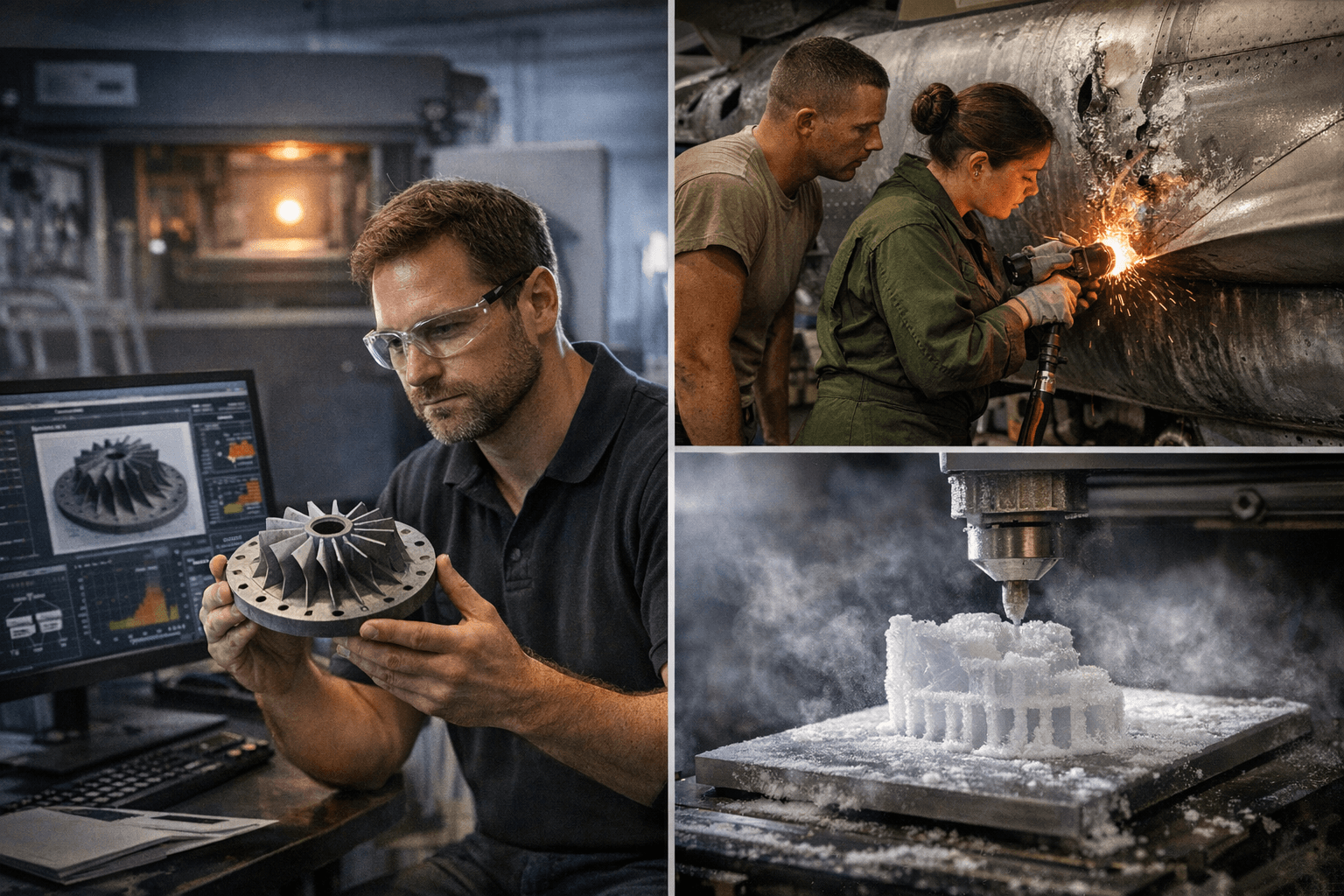
A separate rapid-repair story highlights additive manufacturing’s operational value. NAVAIR’s Additive Manufacturing team supported Marine and Air Force maintainers at Kadena Air Base to 3D-print a right-hand cockpit cooling duct for an F-15. Two prototypes were printed, fit-checked, and installed in under 12 hours, avoiding months of planned downtime and delivering an improved design that reduced print time. The episode illustrates how on-site AM capabilities and established workflows can convert long lead times into same-day fixes, and how iterative prototyping in the field can yield designs that are faster to produce and easier to install.
The third development comes from the University of Amsterdam, where researchers demonstrate a vacuum evaporative-cooling approach to produce freeform ice structures. Using micrometer-scale water jets inside a vacuum chamber, droplets freeze on deposition without cryogenic fluids or support material. The authors report high-fidelity ice builds and highlight potential applications ranging from microfluidic components and tissue-engineering scaffolds to concepts for off-planet construction where traditional materials are scarce. The experiment points to new process windows for printing with phases other than polymers and metal powders.
Taken together, these items show parallel advances in quality systems, operational use, and foundational materials science. Practical takeaways: verify traceability and material records when integrating new software and investors push standards; consider onsite AM and rapid-prototyping workflows for mission-critical repairs to reduce downtime; and watch vacuum-based deposition research for novel manufacturing approaches that could translate into niche lab capabilities. For community labs, maintenance teams, and designers, these developments underscore the value of pairing standards and software with practical, field-ready printing practices and of following emerging process research that may expand what can be printed tomorrow.
Sources:
Know something we missed? Have a correction or additional information?
Submit a Tip