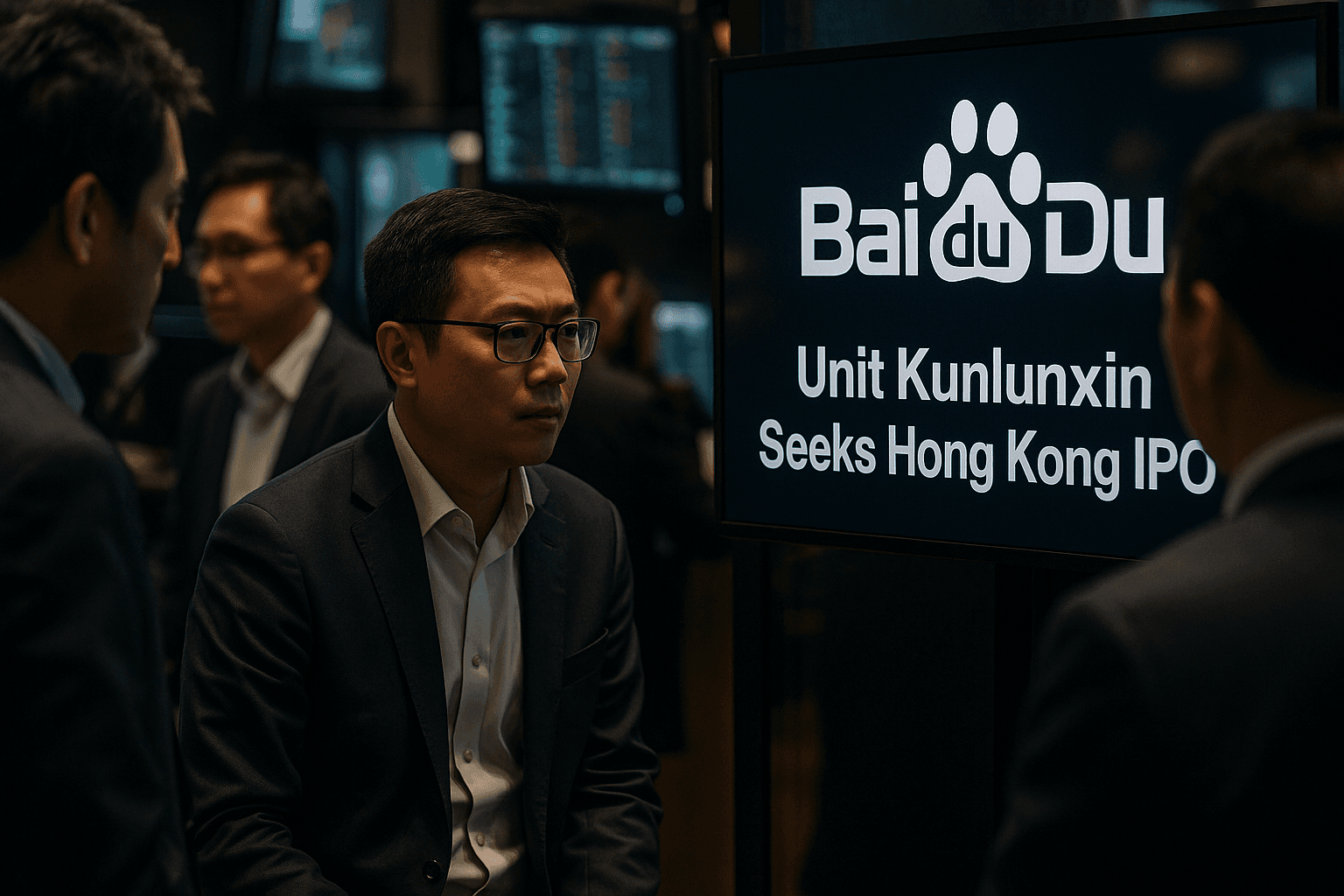
Baidu Unit Kunlunxin Seeks Hong Kong IPO, Sparks Investor Frenzy
Kunlunxin, Baidu's AI chip unit, completed a fundraising that valued the business at about 21 billion yuan roughly 3 billion dollars and is planning a Hong Kong listing, three sources told Reuters on Dec. 5. The move comes as investor appetite for domestic GPU and AI chip makers has surged and Beijing doubles down on efforts to build a homegrown semiconductor industry.

Kunlunxin, the artificial intelligence chip division of Baidu, plans to pursue an initial public offering in Hong Kong after completing a fundraising round that valued the business at about 21 billion yuan roughly 3 billion dollars, three people told Reuters on Dec. 5. The unit aims to file a listing application as early as the first quarter of 2026, according to the people, marking a high profile attempt by one of China’s largest technology companies to tap public markets for chip related capital.
The planned listing reflects a broader surge in investor enthusiasm for domestic makers of graphics processing units and other AI chips, following a string of market debuts that fetched steep premiums. Investors have poured money into firms that supply the compute engines powering large language models and other generative AI applications, driven by expectations of rapid growth and by concerns over access to Western semiconductor technology.
For Baidu, the Kunlunxin offering would serve multiple strategic aims. The unit has been positioned to supply chips and related compute platforms for the company’s own AI services while also competing in a fast evolving domestic market. An IPO would provide a visible valuation benchmark for the business and an infusion of capital that could be used to accelerate development, expand production capacity, and deepen partnerships across the AI ecosystem.
The listing effort also sits squarely within Beijing’s policy priorities. Chinese authorities have made semiconductor self sufficiency a central economic objective, encouraging investment and talent to reduce dependence on foreign suppliers and mitigate export controls imposed by the United States. Public listings of domestic chip companies channel private capital into that push and offer a market test of investor confidence in China’s semiconductor strategy.
Market watchers say enthusiasm for chip related listings has been heightened not only by technical opportunity but by the limited number of large scale domestic producers. Recent successful debuts have lifted valuations across the sector and prompted other companies to consider public offerings while conditions remain favorable. Yet analysts caution that lofty initial valuations can be tested by delivery risks, technological competition, and the capital intensity of chip manufacturing.
Regulatory, geopolitical, and market forces will shape the outcome for Kunlunxin. Hong Kong has increasingly served as a venue for mainland technology listings, offering proximity to Chinese capital and global investors. Any filing and subsequent pricing will depend on market sentiment as well as regulatory approvals and broader conditions in the technology sector.
If Kunlunxin proceeds with the timeline indicated by the sources, investors and competitors will be watching closely in the first quarter of 2026 for a formal application and subsequent pricing decisions. The offering could help define the market for Chinese AI chip makers as they seek to scale up during a period of intense global competition.