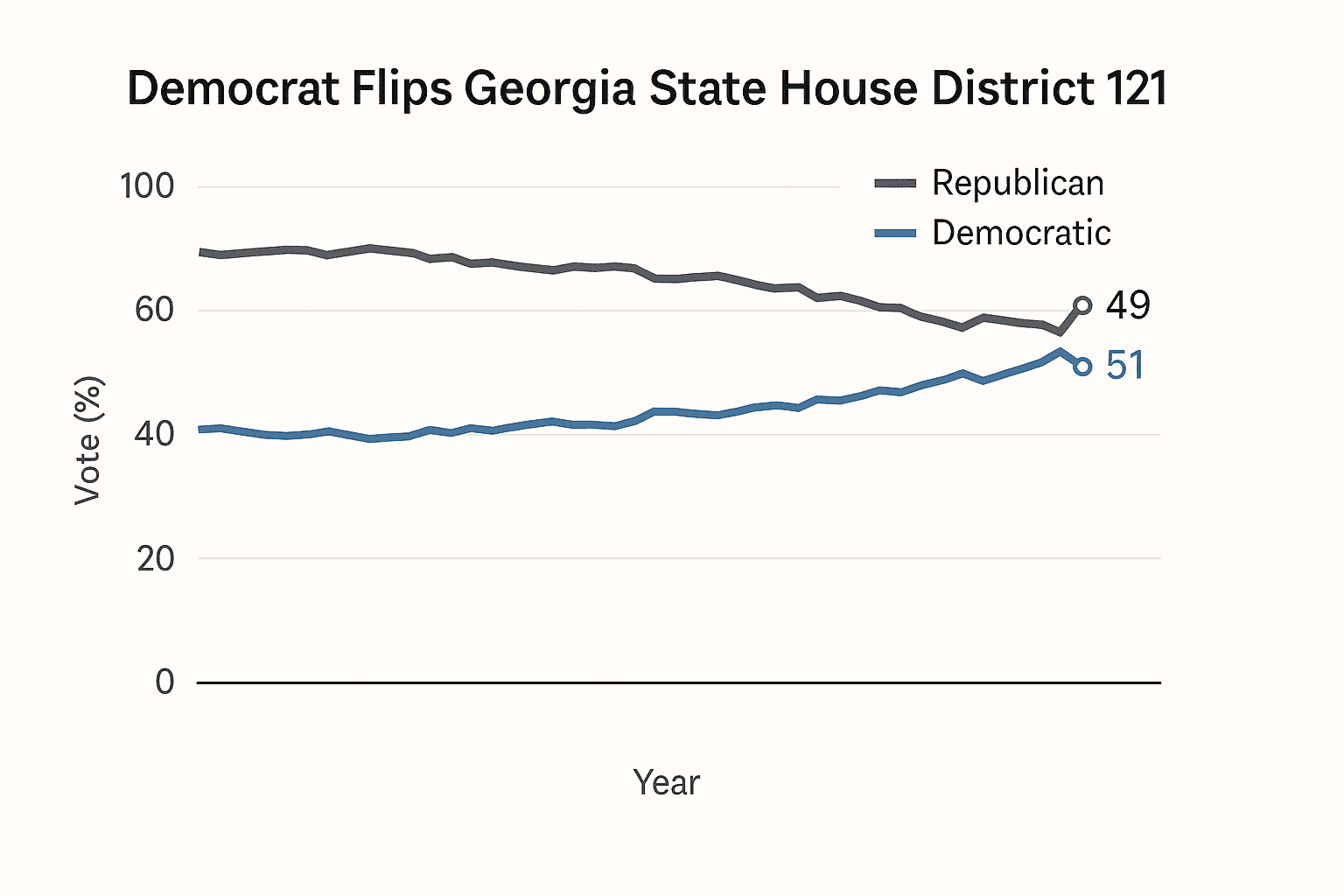
Democrat Flips Historically Republican Georgia Seat, Signals Local Shift
Democrat Eric Gisler claims victory in Georgia’s state House District 121 after a Dec. 9 and 10 special election, narrowly defeating the Republican candidate in a district long held by conservative officeholders. The result is being read as an upset that reflects shifting local dynamics and offers a potential early barometer of Democratic momentum heading into the 2026 campaign season.

Eric Gisler claims a narrow victory in Georgia’s state House District 121 after a special election held over Dec. 9 and 10, an outcome that surprised political operatives and local voters in a district that had been reliably Republican. Media outlets are characterizing the result as an upset, with provisional ballots still possible and the final tally not yet certified. Party strategists on both sides are treating the outcome as a sign of volatile local dynamics and as a potential indicator for the national environment in 2026.
The race drew attention not because of a dramatic policy clash but because of its location and timing. District 121 has been viewed as a Republican safe seat, yet Gisler ran a focused campaign on health care and affordability issues, tapping into concerns that have cut across traditional partisan lines in suburban and exurban communities. Voters in the district reported that rising costs and access to medical care were primary considerations, transforming what was expected to be a routine vote into a competitive contest.
Special elections frequently serve as a laboratory for broader political trends. This contest comes at a moment when suburban voters near metropolitan centers in Georgia and across the country have been reassessing party loyalties, driven by demographic change, economic pressures, and shifts in local cultural dynamics. For Democrats, a flip in a once secure Republican seat offers a morale boost and a tangible narrative to present to donors and voters ahead of next year’s federal and state campaigns. For Republicans, the narrow loss is a prompt to reexamine messaging and outreach in districts where small margins can determine control of legislatures.

State level implications are immediate even if procedural. A single seat can change the arithmetic of committee assignments and narrow the margin in closely divided chambers, shaping the legislative agenda on issues from education funding to state regulatory policy. More broadly, the result feeds into national conversations about the electorate’s priorities, showing that localized campaigning on pocketbook issues can penetrate areas once taken for granted by either party.
International observers and markets often monitor even substate electoral shifts in the United States, given the country’s outsized influence on global policy and investor confidence. Small but consistent signals of political change can affect perceptions abroad about stability and the policy direction of the next federal administration. Diplomats and foreign governments track these trends as part of their assessments of U.S. domestic politics and potential impacts on foreign policy continuity.
As provisional ballots are counted and local election officials move toward certification, both parties will be watching turnout patterns and precinct level swings for lessons they can scale. Whether this flip presages a wider trend or remains an isolated local rebuke will be one of the early political questions entering 2026, with implications that stretch from county courthouses to national campaign strategy.
Sources:
Know something we missed? Have a correction or additional information?
Submit a Tip%3Amax_bytes(150000)%3Astrip_icc()%2FGettyImages-2207587804-8427404b130c43cdbf76608c381b17e6.jpg&w=1920&q=75)