Record Ocean Heat in 2025 Intensifies Storms and Sea-Level Rise
A major international study finds 2025 was the hottest year on record for ocean heat content, extending a nine-year upward streak and deepening risks for coastal communities, food systems and global infrastructure. The findings quantify immediate impacts such as thermal expansion driving sea-level rise and link excess ocean heat to stronger storms, floods and marine ecosystem collapse — underscoring urgent adaptation and mitigation challenges worldwide.

A multinational team led by the Institute of Atmospheric Physics at the Chinese Academy of Sciences reported that the world’s oceans absorbed more heat in 2025 than in any year since modern records began, continuing a nine-year rise in ocean heat content and sharpening climate impacts across the planet. The paper, published in Advances in Atmospheric Sciences on January 9, 2026, was developed by more than 50 scientists from 31 institutions and synthesizes observations from the Chinese Academy of Sciences, Copernicus Marine and the US National Oceanic and Atmospheric Administration.
The study finds that heat stored in the upper 2,000 meters of the ocean increased by about 23 zettajoules in 2025 compared with 2024. The authors offer several stark comparisons to convey scale: that single-year increase is roughly equivalent to enough energy to power an electric car circling the equator a trillion times, about 200 times humanity’s global electricity consumption in 2023, or roughly equal to 37 years of today’s global energy consumption. More than 90 percent of the excess heat from greenhouse gas forcing is taken up by the oceans, and the upper 2,000 meters alone account for about 93 percent of the additional heat in the Earth system.
Those numbers translate into immediate and tangible harms. Thermal expansion from the added heat contributed about 2.49 millimeters to global mean sea-level rise in 2025, increasing flooding risk for low-lying cities, small island states and coastal infrastructure. Warmer seas also heat and moisten the atmosphere, increasing evaporation and loading storms with extra moisture; the study links the record ocean heat to stronger storms, intensified rainfall extremes and heightened risks of hurricanes, floods and droughts.
The researchers connect the ocean warming to a string of devastating events in 2025 that exemplify the new, higher-stakes climate dynamics. In Southeast Asia, an intense July monsoon dropped more than 788 millimeters of rain in some locations over five days. November floods across Indonesia, Sri Lanka, Thailand and Vietnam reportedly killed more than 1,350 people. In the United States, a flash flood in Central Texas during the Fourth of July weekend reportedly killed at least 138 people. The study frames these as examples of “supercharged” storms that carry and dump more moisture because of warmer ocean temperatures.
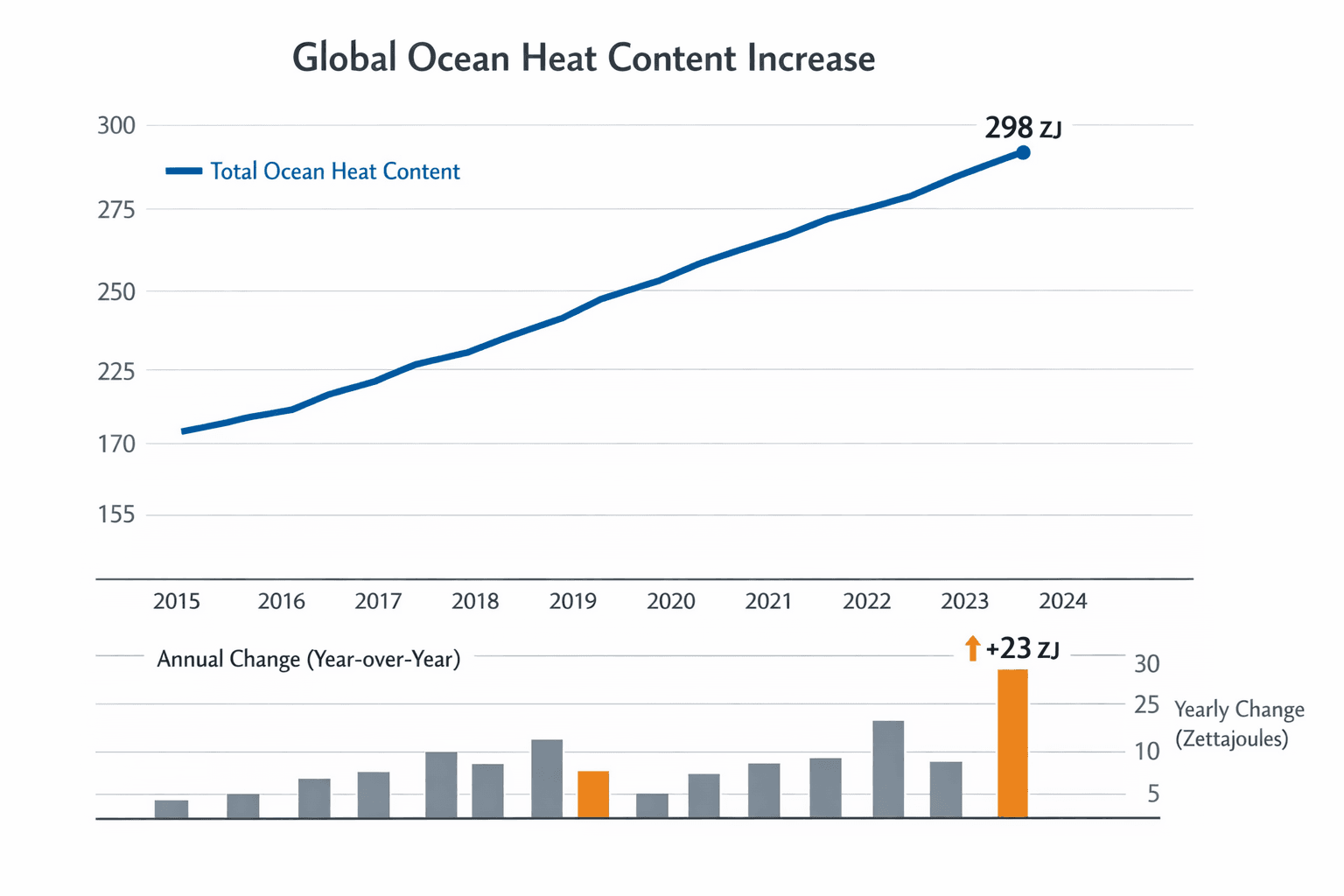
The paper stresses that natural climate oscillations such as El Niño and La Niña can modulate where and when ocean warming is most acute, but they do not alter the long-term upward trend driven by human greenhouse gas emissions. The researchers place the 2025 record in the context of roughly 125 years of modern measurements, emphasizing that the trend reflects a persistent planetary energy imbalance.
The findings carry clear policy implications: rising ocean heat intensifies short-term disaster risk while eroding the resilience of fisheries, coastal economies and ecosystems. For vulnerable nations and communities, the report reinforces calls for accelerated emissions cuts, expanded climate finance for adaptation and loss-and-damage measures, and strengthened international cooperation on ocean monitoring and early warning systems.
Sources:
Know something we missed? Have a correction or additional information?
Submit a Tip