Senate Advances Resolution to Block Further Trump Military Action in Venezuela
The Senate voted 52-47 to advance a bipartisan war powers resolution that would require President Trump to obtain congressional authorization before using U.S. forces in or against Venezuela. The measure represents a rare cross-party assertion of legislative authority following a U.S. raid in Caracas that captured Venezuelan President Nicolás Maduro and his wife, and it sharpens an institutional clash over the limits of presidential war-making.
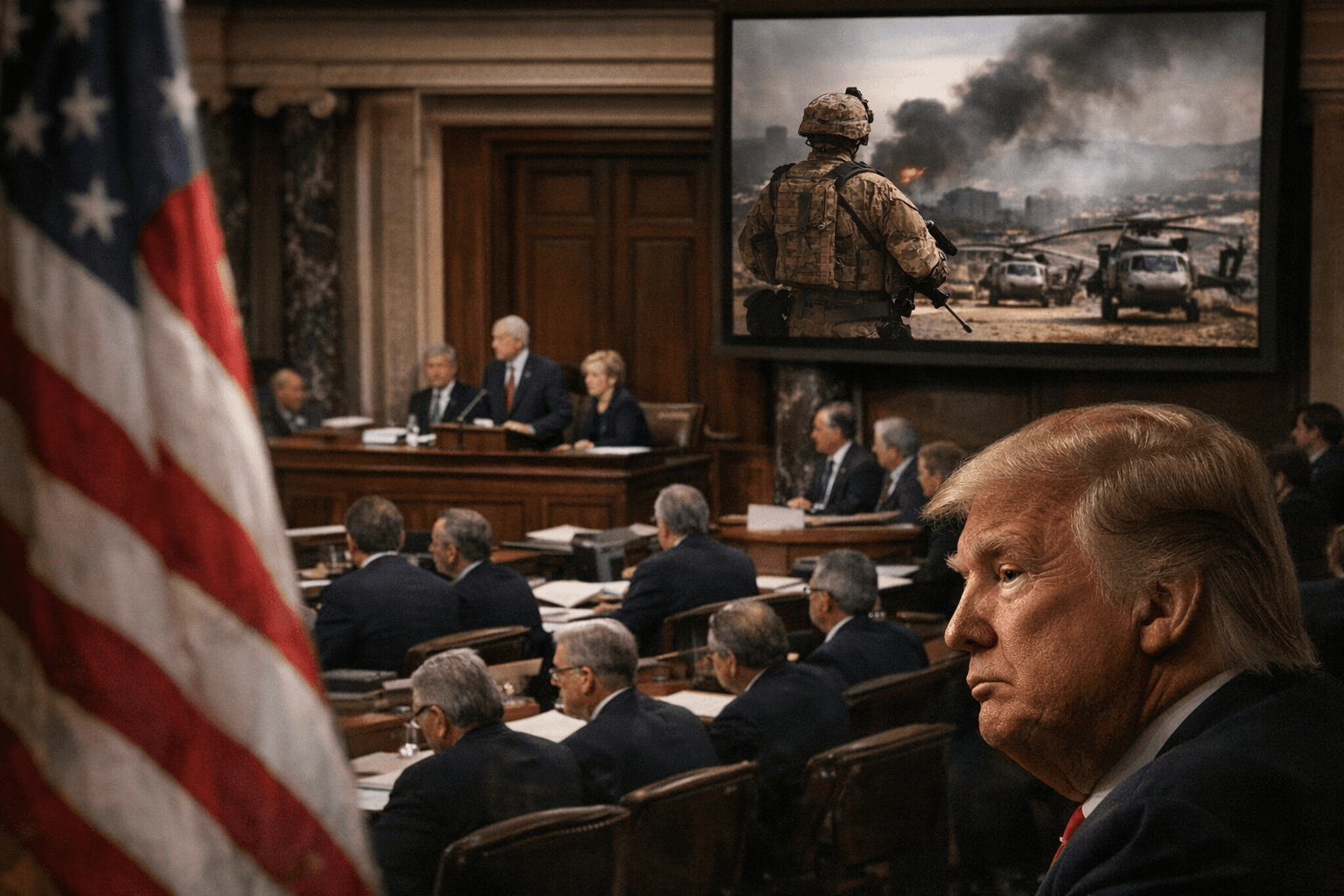
The Senate on Thursday moved forward with a resolution designed to bar the president from conducting further military hostilities in or against Venezuela without express congressional approval, approving a procedural motion 52-47 to begin debate. The vote cleared the 51-vote threshold needed to advance the measure and set a likely final Senate vote for the coming days.
Every Senate Democrat supported advancing the resolution, and five Republicans crossed party lines: Sens. Rand Paul of Kentucky, Lisa Murkowski of Alaska, Susan Collins of Maine, Todd Young of Indiana, and Josh Hawley of Missouri. One Republican senator did not cast a vote. Supporters described the outcome as a congressional reassertion of the constitutional role of lawmakers in decisions of war and peace.
If enacted, the measure would require the president to seek specific authorization from Congress before ordering further U.S. military operations in Venezuela. Sponsors framed the resolution as a response to recent unilateral action and as an attempt to prevent additional escalation without legislative backing.
The vote follows a highly consequential U.S. operation in Caracas days earlier in which Venezuelan President Nicolás Maduro and his wife were captured. Both face federal charges in the United States, including narcoterrorism conspiracy and conspiracy to import cocaine, and they entered not-guilty pleas earlier in the week. Lawmakers received briefings from senior administration officials on U.S. policy toward Venezuela in the days leading up to the Senate debate.
Senate leaders and backers of the measure cast the vote as an institutional check. Senate Majority Leader Chuck Schumer said the chamber must assert "the authority given to it in the Constitution on matters of war and peace" and that the vote sends a message of "no more endless wars." Senator Tim Kaine, a member of the Armed Services Committee, pushed for an immediate congressional response after the Caracas operation.
Republican senators who supported advancing the resolution framed their decisions in constitutional terms. Senator Rand Paul, writing in an editorial, argued that "bombing another nation’s capital and removing their leader is an act of war plain and simple" and that "the Constitution does not vest such power solely in the presidency." The president reacted sharply on his social media platform, writing that the "quartet" of Republicans who opposed him should be "ashamed" and "should never be elected to office again."
The measure faces steep hurdles even if the Senate ultimately approves final passage. It must also pass the Republican-led House of Representatives and would face an almost certain veto from the president. Overriding a veto would require two-thirds majorities in both chambers, a threshold that observers say is unlikely to be met. Earlier efforts to limit executive authority on Venezuela were blocked in November by a 51-49 margin, underscoring how fragile cross-party coalitions can be.
Beyond its immediate prospects, the vote highlights widening fractures within the Republican caucus over the administration's increasingly assertive use of military force in the Western Hemisphere and renews a broader congressional debate about where the constitutional line sits between presidential initiative and legislative authorization for war.
Know something we missed? Have a correction or additional information?
Submit a Tip