U.S. and Ukraine Advance Talks in Miami on Peace Framework
U.S. special envoys met Ukrainian negotiators in Miami for a second day of briefings on a U.S. backed framework aimed at ending the nearly four year war in Ukraine, with officials saying progress was made on security arrangements. The sessions hinge on Moscow's willingness to de escalate and accept durable guarantees, a condition that will determine whether these talks translate into a formal deal with broad geopolitical and market implications.

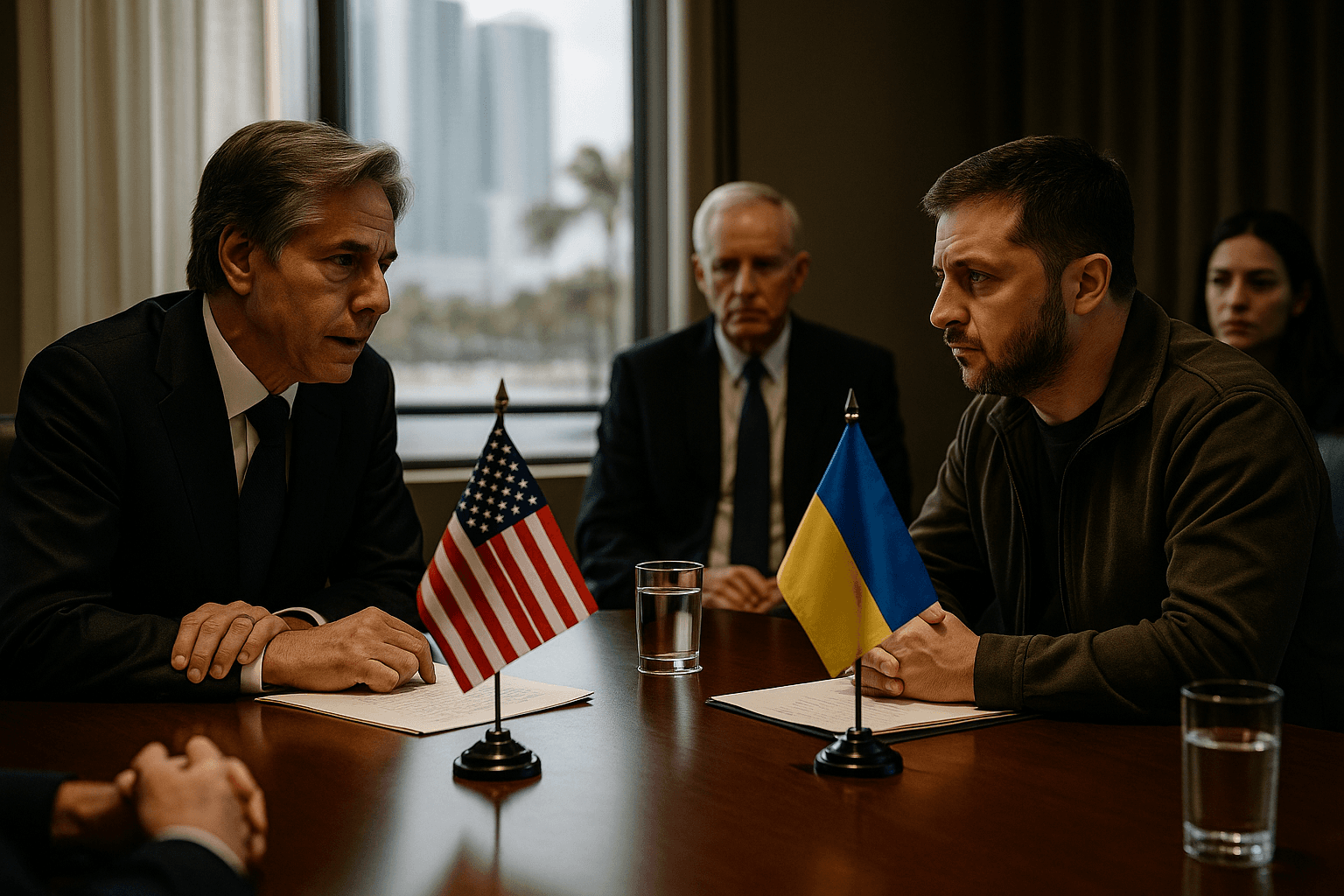
U.S. special envoy Steve Witkoff and Jared Kushner spent a second day in Miami on December 5 briefing Ukraine's lead negotiator Rustem Umerov and other Ukrainian officials on a U.S. backed framework intended to produce a settlement to the war that began with Russia's full scale invasion in February 2022. The Miami meetings followed a five hour session at the Kremlin earlier in the week where Witkoff and Kushner had presented elements of the plan directly to President Vladimir Putin.
Participants on both sides said the conversations produced progress on the outline of a security framework, while underscoring that any substantive agreement would require a credible Russian commitment to de escalation and lasting security guarantees. U.S. and Ukrainian officials agreed to reconvene after briefing their respective leaders, and described the Miami sessions as productive but not formal negotiations.
The Kremlin summarized its encounter with the U.S. envoys as "constructive and friendly," language that Moscow has used in the past to signal interest in exploring diplomatic openings without committing to binding concessions. Analysts said the careful phrasing reflects the diplomatic complexity of bridging Ukrainian demands for full territorial integrity and return of occupied lands, Western insistence on enforceable guarantees and sanctions, and Russian demands for security assurances and recognition of outcomes on the ground.
Beyond protocol and political posturing, the talks carry tangible economic and market implications. A credible move toward de escalation would likely ease some of the war induced volatility in global energy and commodity markets, reduce the premium that investors place on geopolitical risk, and over time alter trajectories for European defense spending. Conversely, without a reliable monitoring and enforcement mechanism, markets would treat any agreement as fragile, preserving elevated risk premia in energy, defense related equities, and sovereign spreads in bordering economies.
Policy makers face hard trade offs. Western capitals must weigh the political costs of conceding territory against the economic burden and human toll of prolonged conflict. For Kyiv, security guarantees backed by international enforcement and a timeline for reconstruction finance are central to any calculation of political feasibility. For Washington, the challenge is to craft guarantees that satisfy Kyiv without leaving NATO or its partners exposed to new strategic risks.
Longer term, the talks mark a potential inflection point in a war that has reshaped Europe's security architecture, accelerated military modernization and rerouted global supply chains. If the framework evolves into a durable arrangement, it will prompt a re assessment of defense budgets, energy diversification strategies and reconstruction financing across Europe. If it does not, the diplomatic shuttle in cities like Miami may be remembered as another attempt that eased tensions temporarily but left the core dispute unresolved.